
 Wildlife
of Vietnam
Oriental Pied Hornbill
Hornbills, Hoopoes & Trogons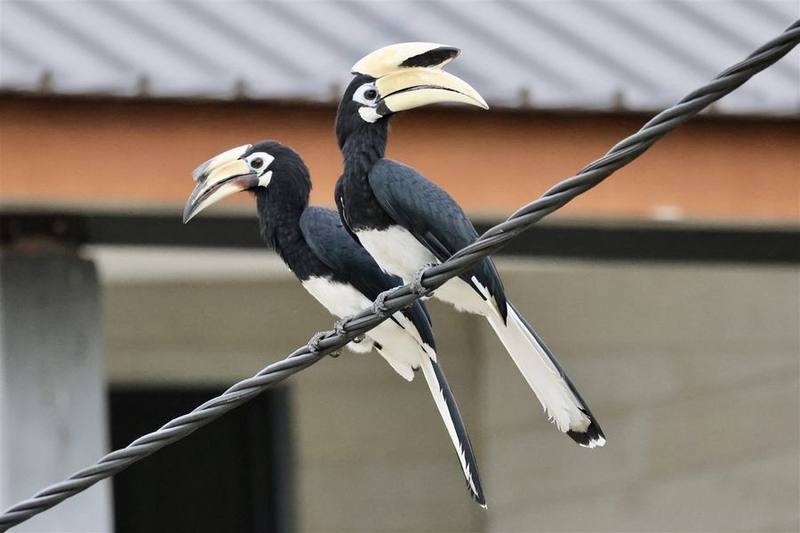
Photo: Yu Chu Chin · CC BY-SA 4.0 (May be cropped or resized)
Anthracoceros albirostris
Rare visitor: recorded only occasionally in this country
Basic stats
Diet
Wild fruits (figs, berries, palm fruit, papaya, lianas); also insects, shellfish, small reptiles, small mammals and birds and their eggs
Habitat
Forest canopy and plantation
Range
Indian subcontinent and throughout Southeast Asia
Size
55–60cm
The Oriental pied hornbill is a large canopy-dwelling bird of the hornbill family, a medium-sized frugivore 55–60 cm long, with a bill of 19 cm in males and 16 cm in females. The head, neck, back, wings and upper breast are black with a slight green sheen, and the tail is black with white tips on all feathers except the central pair. The sexes are similar, and juveniles resemble the adults but have an undeveloped casque and a smaller bill (Wikipedia, general species account).
It has the largest distribution in its genus, occurring in the Indian subcontinent and throughout Southeast Asia. Its calls are described as crow-like, braying, or harsh crackles and screeches. Its diet is mainly wild fruit such as figs, berries, palm fruit, papaya and the fruits of lianas, and also insects, shellfish, small reptiles and small mammals and birds, including eggs, and it differs slightly between the breeding and non-breeding seasons.
Quick answers
- What does the Oriental Pied Hornbill eat?
- Wild fruits (figs, berries, palm fruit, papaya, lianas); also insects, shellfish, small reptiles, small mammals and birds and their eggs
- What habitat does the Oriental Pied Hornbill live in?
- Forest canopy and plantation
- Where is the Oriental Pied Hornbill found?
- Indian subcontinent and throughout Southeast Asia
- How big is the Oriental Pied Hornbill?
- 55–60cm
In Vietnam
GBIF holds 2,485 records of the Oriental Pied Hornbill from 9 protected areas in Vietnam, dated 1984 to 2026. Most come from Cat Tien National Park and Dong Nai Culture and Nature Reserve.
Where it has been recorded
- Cat Tien National Park 2,324 records, latest 2026
- Dong Nai Culture and Nature Reserve 52 records, latest 2024
- Ha Long Bay - Cat Ba Archipelago 39 records, latest 2024
- Phu Quoc National Park 21 records, latest 2024
- Yok Don National Park 14 records, latest 2020
- Lo Go - Xa Mat National Park 13 records, latest 2001
- Phong Nha-Ke Bang National Park 12 records, latest 2023
- Cuc Phuong National Park 6 records, latest 2019
Plus 1 more sites.
Covered in our place guides: Cat Tien National Park, Yok Don National Park, Phong Nha-Ke Bang National Park, Cuc Phuong National Park.
Also in our other guides: Bhutan, India, Malaysia, Nepal, Singapore, Sumatra, Thailand.
Records: GBIF occurrence data matched to park boundaries (© OpenStreetMap contributors, ODbL; Wikidata). Counts show recording effort, not how common the species is.