
 Wildlife
of Vietnam
Oriental Bay Owl
Owls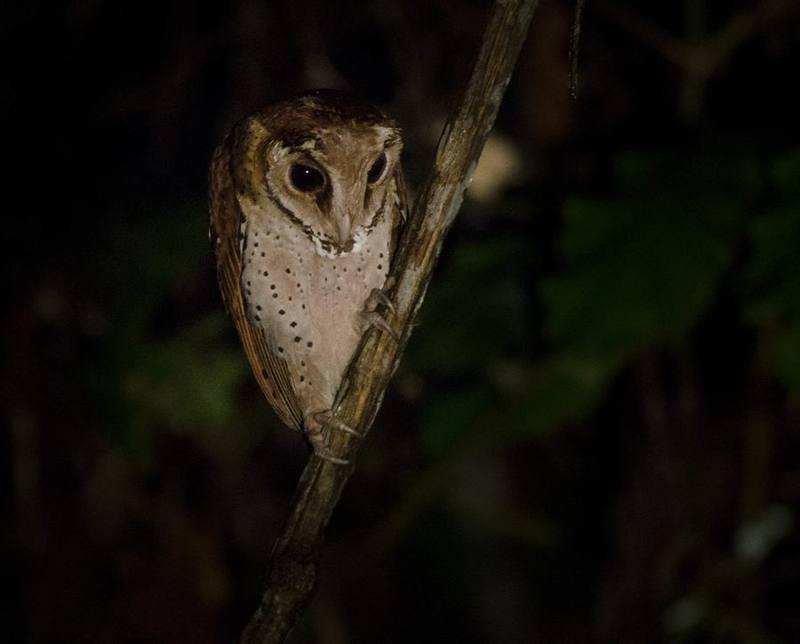
Photo: Mike Gordon — wildlifeofeverywhere.com · Project photograph
Phodilus badius
Rare visitor: recorded only occasionally in this country
Basic stats
Habitat
Tropical wet evergreen forest; from 200m up to about 2,300m
Range
Throughout Southeast Asia and parts of India
Incubation period
About 36–42 days
Size
22.5–29cm
Weight
255–308g
The Oriental bay owl is a small, completely nocturnal owl with a heart-shaped face with ear-like extensions and a highly angular head. The top and back are deep chestnut and the underparts cream and tan, with large black eyes. Total body length is 22.5 to 29cm and weight 255 to 308g. It is found throughout Southeast Asia and parts of India (Wikipedia, general species account).
It lives in tropical wet evergreen forest at elevations from 200m up to about 2,300m depending on the area. It hoots, screams and gives high-pitched whistle songs, typically four to seven melancholy whistles lasting two to eight seconds. Both parents care for the young, breeding is usually March to May, and incubation lasts about 36 to 42 days. The account opened does not name Bhutan.
Quick answers
- What habitat does the Oriental Bay Owl live in?
- Tropical wet evergreen forest; from 200m up to about 2,300m
- Where is the Oriental Bay Owl found?
- Throughout Southeast Asia and parts of India
- How long are the eggs of the Oriental Bay Owl incubated?
- About 36–42 days
- How big is the Oriental Bay Owl?
- 22.5–29cm
- How much does the Oriental Bay Owl weigh?
- 255–308g
In Vietnam
GBIF holds 52 records of the Oriental Bay Owl from 3 protected areas in Vietnam, dated 1989 to 2024. Most come from Cat Tien National Park and Binh Chau - Phuoc Buu Nature Reserve.
Where it has been recorded
- Cat Tien National Park 43 records, latest 2024
- Binh Chau - Phuoc Buu Nature Reserve 6 records, latest 2024
- Dong Nai Culture and Nature Reserve 3 records, latest 2022
Covered in our place guides: Cat Tien National Park.
Also in our other guides: Bhutan.
Records: GBIF occurrence data matched to park boundaries (© OpenStreetMap contributors, ODbL; Wikidata). Counts show recording effort, not how common the species is.