
 Wildlife
of Vietnam
Watercock
Cranes, Rails & Bustards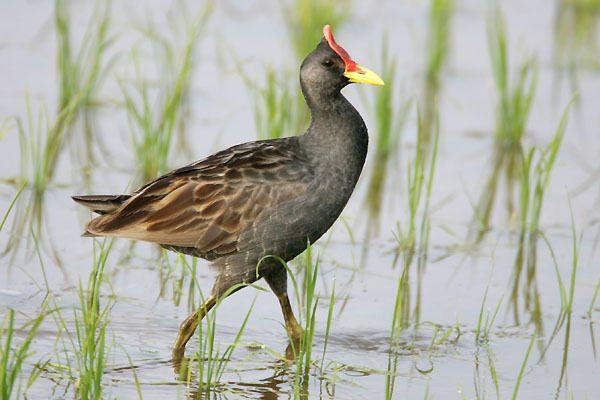
Photo: Kim, Hyun-tae · CC BY 4.0 (May be cropped or resized)
Gallicrex cinerea
Rare visitor: recorded only occasionally in this country
Basic stats
Diet
Insects, small fish and seeds
Habitat
Swamps
Range
India, Pakistan and Sri Lanka to south China, Korea, Japan, the Philippines and Indonesia
Clutch size
3–6 eggs
Size
43cm (male), 36cm (female)
Weight
476–650g (male), 298–434g (female)
The watercock is a large rail and the only member of its genus. Adult males are about 43cm long and 476–650g, with mainly black-grey plumage and a red bill, legs, extended frontal shield and a horn-like crest. Females are smaller, about 36cm and 298–434g, dark brown above and paler below with darker streaks and bars, a yellow bill and green legs. Young males are buff and darken as they mature. Although the male looks like a moorhen, it belongs to a mainly tropical Asian group of rails (Wikipedia, general species account).
It breeds in swamps and is mainly a permanent resident. It is quite secretive but is sometimes seen in the open, and it is noisy, especially at dawn and dusk, with a loud, gulping call. It probes mud and shallow water and picks food by sight, foraging on the ground for insects, small fish and seeds. The nest is placed on dry ground in marsh vegetation and holds three to six eggs. SoIB 2023 lists it as resident in India with movements within the country, finds its current trend stable, and rates it a Low conservation priority (Wikipedia, general species account; SoIB 2023).
Quick answers
- What does the Watercock eat?
- Insects, small fish and seeds
- What habitat does the Watercock live in?
- Swamps
- Where is the Watercock found?
- India, Pakistan and Sri Lanka to south China, Korea, Japan, the Philippines and Indonesia
- How many eggs does the Watercock lay?
- 3–6 eggs
- How big is the Watercock?
- 43cm (male), 36cm (female)
- How much does the Watercock weigh?
- 476–650g (male), 298–434g (female)
In Vietnam
GBIF holds 42 records of the Watercock from 3 protected areas in Vietnam, dated 1989 to 2024. Most come from Cat Tien National Park and Van Long Nature Reserve.
Where it has been recorded
- Cat Tien National Park 30 records, latest 2024
- Van Long Nature Reserve 8 records, latest 2022
- Dong Nai Culture and Nature Reserve 4 records, latest 2024
Covered in our place guides: Cat Tien National Park, Van Long Nature Reserve.
Also in our other guides: China, India, Malaysia, Nepal, Singapore, Sri Lanka, Sumatra, Thailand.
Records: GBIF occurrence data matched to park boundaries (© OpenStreetMap contributors, ODbL; Wikidata). Counts show recording effort, not how common the species is.