
 Wildlife
of Vietnam
Red-headed Trogon
Hornbills, Hoopoes & Trogons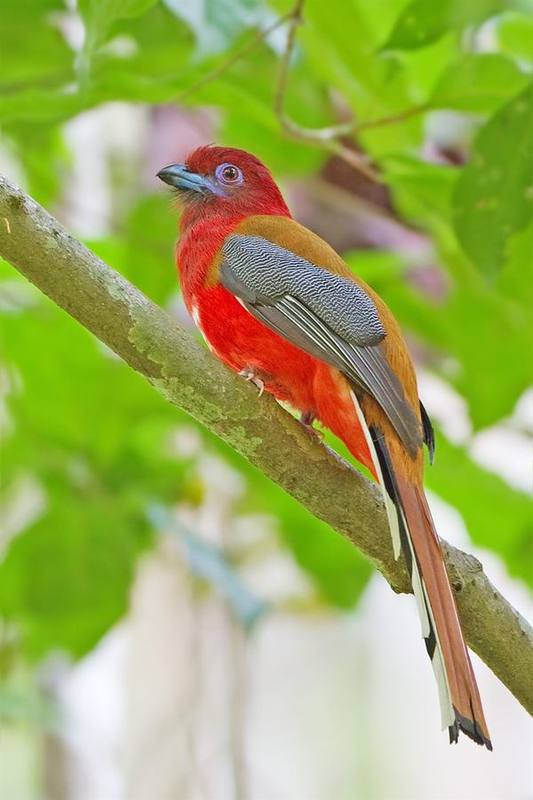
Photo: JJ Harrison · CC BY-SA 3.0 (May be cropped or resized)
Harpactes erythrocephalus
Rare visitor: recorded only occasionally in this country
Basic stats
Diet
Invertebrates; also leaves and fruit
Habitat
Dense broadleaved upland forest in the Himalayan foothills; broadleaved evergreen forest at 300–2,600m
Range
North-eastern India, Bhutan and Bangladesh to Southeast Asia
Size
About 34cm
The red-headed trogon is on average 34 cm long. The male has a red head and breast, unique in the trogons, with a narrow white band across the mid-breast, a light red to pink lower breast and abdomen, pale red on the flanks and a rusty-brown mantle and back. The female looks like Diard's trogon without a speckled undertail. It is fairly common in north-eastern India, frequent in Bhutan and locally dispersed in Bangladesh, preferring upland forests (Wikipedia, general species account).
It is often seen perching on shaded branches waiting for prey, alone or in pairs, and follows flocks of foraging birds to take advantage of the insects they flush. It also feeds on leaves and fruits. Most birds are sedentary, though some move between elevations. In northern India females lay eggs between mid-April and mid-July, with a peak in May and June. SoIB 2023 rates it a Low conservation priority, a resident forest bird that eats invertebrates, with a Moderate range of about 62,000 km² (Wikipedia, general species account; SoIB 2023).
Quick answers
- What does the Red-headed Trogon eat?
- Invertebrates; also leaves and fruit
- What habitat does the Red-headed Trogon live in?
- Dense broadleaved upland forest in the Himalayan foothills; broadleaved evergreen forest at 300–2,600m
- Where is the Red-headed Trogon found?
- North-eastern India, Bhutan and Bangladesh to Southeast Asia
- How big is the Red-headed Trogon?
- About 34cm
In Vietnam
GBIF holds 1,181 records of the Red-headed Trogon from 16 protected areas in Vietnam, dated 1926 to 2026. Most come from Cuc Phuong National Park and Bach Ma National Park.
Where it has been recorded
- Cuc Phuong National Park 411 records, latest 2024
- Bach Ma National Park 213 records, latest 2024
- Da Lat Plateau & Bidoup-Nui Ba 114 records, latest 2024
- Phong Nha-Ke Bang National Park 106 records, latest 2024
- Cat Tien National Park 91 records, latest 2026
- Ba Vi National Park 70 records, latest 2026
- Tam Dao National Park 70 records, latest 2026
- Ngoc Linh Nature Reserve 55 records, latest 2024
Plus 8 more sites.
Covered in our place guides: Cuc Phuong National Park, Bach Ma National Park, Da Lat Plateau & Bidoup-Nui Ba, Phong Nha-Ke Bang National Park, Cat Tien National Park.
Seen on trips we host
- Birding with a Camera (Dorian Anderson) Tropical Birding, 2025
- Vietnam scheduled Bird Tour Asia, 2015
- Vietnam scheduled Bird Tour Asia, 2018
Also in our other guides: India, Malaysia, Sumatra.
Records: GBIF occurrence data matched to park boundaries (© OpenStreetMap contributors, ODbL; Wikidata). Counts show recording effort, not how common the species is.