
 Wildlife
of Vietnam
Puff-throated Babbler
Babblers, Laughingthrushes & White-eyes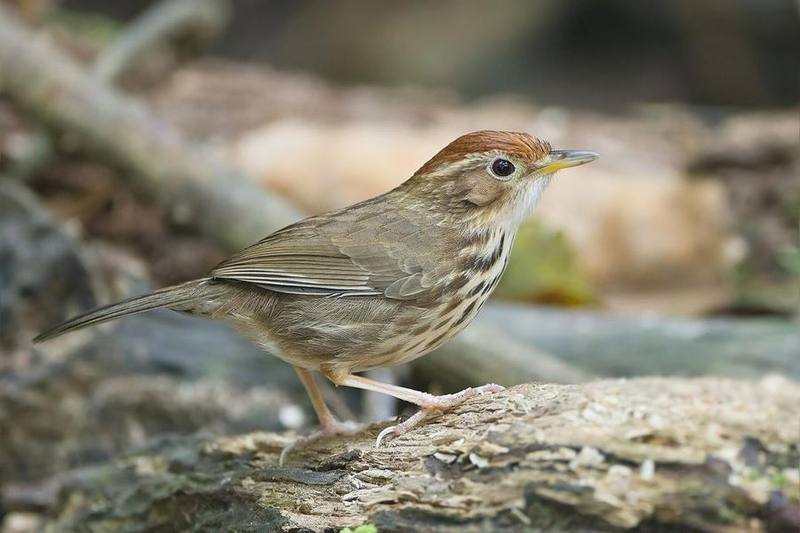
Photo: JJ Harrison (https://www.jjharrison.com.au/) · CC BY-SA 3.0 (May be cropped or resized)
Pellorneum ruficeps
Rare visitor: recorded only occasionally in this country
Basic stats
Diet
Insects, turned from leaf litter
Habitat
Scrub and moist forest mainly in hilly regions; forages in small groups on the forest floor, low in the undergrowth
Range
Common resident breeder in the Himalayas and the forests of Asia
Clutch size
2–5 eggs; larger in northern populations
Incubation period
Young fledge about 12–13 days after hatching
The puff-throated babbler, or spotted babbler, is found in scrub and moist forest mainly in hilly regions of Asia, and is a common resident breeder in the Himalayas. It is brown above and white below, with heavy brown streaks towards the breast and belly; the white throat is sometimes puffed out, giving the English name. Many regional forms are named, with mandellii in the east, streaked on the back and nape (Wikipedia, general species account).
They forage in small groups on the forest floor, turning over leaf litter to find prey and usually staying low in the undergrowth, where they can be hard to spot; at first glance one can look like a song thrush. They have loud, distinct calls including a morning song, contact and alarm calls. The clutch is two to five eggs, with northern populations tending towards larger clutches.
Quick answers
- What does the Puff-throated Babbler eat?
- Insects, turned from leaf litter
- What habitat does the Puff-throated Babbler live in?
- Scrub and moist forest mainly in hilly regions; forages in small groups on the forest floor, low in the undergrowth
- Where is the Puff-throated Babbler found?
- Common resident breeder in the Himalayas and the forests of Asia
- How many eggs does the Puff-throated Babbler lay?
- 2–5 eggs; larger in northern populations
- How long are the eggs of the Puff-throated Babbler incubated?
- Young fledge about 12–13 days after hatching
In Vietnam
GBIF holds 1,562 records of the Puff-throated Babbler from 16 protected areas in Vietnam, dated 1927 to 2026. Most come from Cat Tien National Park and Cuc Phuong National Park.
Where it has been recorded
- Cat Tien National Park 939 records, latest 2026
- Cuc Phuong National Park 409 records, latest 2024
- Dong Nai Culture and Nature Reserve 95 records, latest 2024
- Phong Nha-Ke Bang National Park 34 records, latest 2024
- Son Tra special-use forest 15 records, latest 2024
- Tam Dao National Park 12 records, latest 2018
- Phu Quoc National Park 10 records, latest 2023
- Bach Ma National Park 8 records, latest 2023
Plus 8 more sites.
Covered in our place guides: Cat Tien National Park, Cuc Phuong National Park, Phong Nha-Ke Bang National Park, Bach Ma National Park, Van Long Nature Reserve.
Seen on trips we host
- Vietnam scheduled Bird Tour Asia, 2020
Also in our other guides: Bhutan.
Records: GBIF occurrence data matched to park boundaries (© OpenStreetMap contributors, ODbL; Wikidata). Counts show recording effort, not how common the species is.