
 Wildlife
of Vietnam
Osprey
Birds of Prey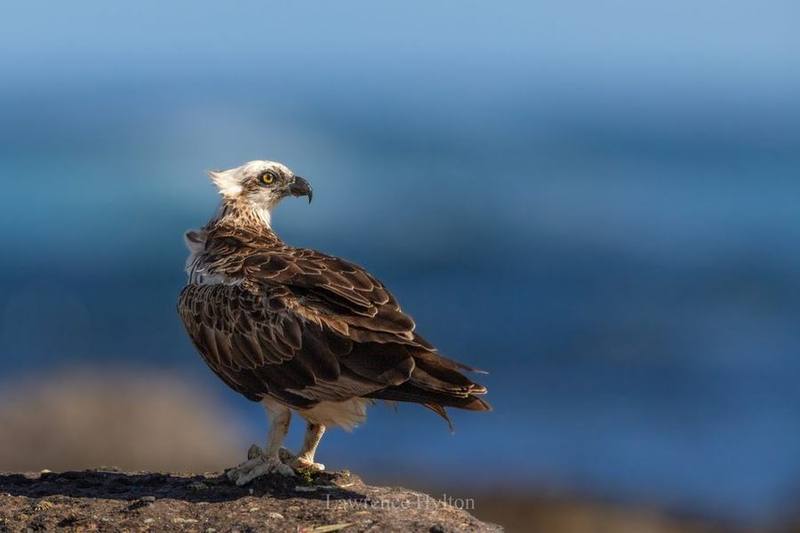
Photo: Lawrence Hylton · CC BY 4.0 (May be cropped or resized)
Pandion haliaetus
Rare visitor: recorded only occasionally in this country
Basic stats
Diet
Almost exclusively fish
Habitat
Near water with a good supply of fish
Range
Every continent except Antarctica
Size
50–66cm
Wingspan
127–180cm
Weight
0.9–2.1kg
The osprey is a large fish-eating raptor, 50–66cm long with a wingspan of 127–180cm and a weight of 0.9–2.1kg. It is deep glossy brown above, with a white breast and greyish head and underparts. It differs from other hawks in several ways: its toes are of equal length, its talons are rounded rather than grooved, and, like owls, it can reverse its outer toe to grip prey with two toes in front and two behind, a great help in holding slippery fish. It is the only living member of its genus and family (Wikipedia, general species account).
It is the second most widely distributed raptor after the peregrine falcon, found on every continent except Antarctica, though only as a non-breeding migrant in South America. It lives in a wide range of habitats, always near water that can supply enough food, and its prey is almost entirely fish, caught with a specialised hunting technique. In India it is a winter migrant with a large range. SoIB 2023 estimates a long-term decline of about 62% and a current fall of about 5.5% a year, and rates it a High conservation priority (Wikipedia, general species account; SoIB 2023).
Quick answers
- What does the Osprey eat?
- Almost exclusively fish
- What habitat does the Osprey live in?
- Near water with a good supply of fish
- Where is the Osprey found?
- Every continent except Antarctica
- How big is the Osprey?
- 50–66cm
- What is the wingspan of the Osprey?
- 127–180cm
- How much does the Osprey weigh?
- 0.9–2.1kg
In Vietnam
GBIF holds 915 records of the Osprey from 15 protected areas in Vietnam, dated 1986 to 2026. Most come from Cat Tien National Park and Da Lat Plateau & Bidoup-Nui Ba.
Where it has been recorded
- Cat Tien National Park 806 records, latest 2026
- Da Lat Plateau & Bidoup-Nui Ba 35 records, latest 2024
- Dong Nai Culture and Nature Reserve 10 records, latest 2023
- Phu Quoc National Park 9 records, latest 2024
- Con Dao National Park 8 records, latest 2024
- Can Gio Mangrove Biosphere Reserve 7 records, latest 2024
- Cuc Phuong National Park 6 records, latest 2016
- Yok Don National Park 6 records, latest 2018
Plus 7 more sites.
Covered in our place guides: Cat Tien National Park, Da Lat Plateau & Bidoup-Nui Ba, Con Dao National Park, Cuc Phuong National Park, Yok Don National Park, Tram Chim National Park.
Seen on trips we host
- Vietnam scheduled Bird Tour Asia, 2018
Also in our other guides: India, Nepal.
Records: GBIF occurrence data matched to park boundaries (© OpenStreetMap contributors, ODbL; Wikidata). Counts show recording effort, not how common the species is.