
 Wildlife
of Vietnam
Maroon Oriole
Crows, Drongos, Orioles & Shrikes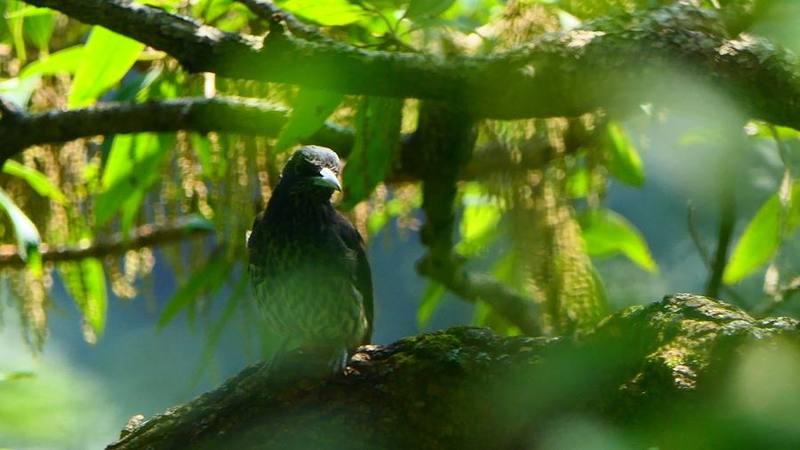
Photo: (c) Piyush Marwadi, some rights reserved (CC BY) · CC-BY (May be cropped or resized)
Oriolus traillii
Rare visitor: recorded only occasionally in this country
Basic stats
Diet
Wild figs, berries, insects and nectar
Habitat
Forest; nest is a deep cup of bast fibre bound with cobwebs
Range
Bangladesh, Bhutan, Cambodia, India, Laos, Myanmar, Nepal, Taiwan, Thailand, Tibet and Vietnam; in India from Himachal Pradesh east to Arunachal Pradesh and the hills of Manipur
Size
25–28cm
The maroon oriole is 25–28 cm long. The adult male is glossy crimson-maroon with a black head, neck and wings and a chestnut-maroon tail, with a bluish bill; females and immature males have greyish-white underparts with black streaks. Colours vary across the range, duller in the Indian subcontinent and brighter and more reddish in Southeast Asia (Wikipedia, general species account).
It is found in Bangladesh, Bhutan, Cambodia, India, Laos, Myanmar, Nepal, Taiwan, Thailand, Tibet and Vietnam; in India it ranges from Himachal Pradesh east to Arunachal Pradesh and the hills of Manipur. The nesting season is April to May, and it eats wild figs, berries, insects and nectar. SoIB 2023 rates it a Low conservation priority, a resident and local migrant of forest with a Moderate range of about 128,000 km² and inconclusive trends (Wikipedia, general species account; SoIB 2023).
Quick answers
- What does the Maroon Oriole eat?
- Wild figs, berries, insects and nectar
- What habitat does the Maroon Oriole live in?
- Forest; nest is a deep cup of bast fibre bound with cobwebs
- Where is the Maroon Oriole found?
- Bangladesh, Bhutan, Cambodia, India, Laos, Myanmar, Nepal, Taiwan, Thailand, Tibet and Vietnam; in India from Himachal Pradesh east to Arunachal Pradesh and the hills of Manipur
- How big is the Maroon Oriole?
- 25–28cm
In Vietnam
GBIF holds 568 records of the Maroon Oriole from 10 protected areas in Vietnam, dated 1988 to 2024. Most come from Da Lat Plateau & Bidoup-Nui Ba and Cuc Phuong National Park.
Where it has been recorded
- Da Lat Plateau & Bidoup-Nui Ba 272 records, latest 2024
- Cuc Phuong National Park 142 records, latest 2024
- Ngoc Linh Nature Reserve 97 records, latest 2024
- Bac Huong Hoa Nature Reserve 26 records, latest 2024
- Cat Tien National Park 10 records, latest 2023
- Xuan Lien National Park 6 records, latest 2013
- Kon Chu Rang Nature Reserve 6 records, latest 2019
- Tam Dao National Park 3 records, latest 2019
Plus 2 more sites.
Covered in our place guides: Da Lat Plateau & Bidoup-Nui Ba, Cuc Phuong National Park, Cat Tien National Park.
Seen on trips we host
- Vietnam Bird Tour Asia, 2023
Also in our other guides: India, Nepal.
Records: GBIF occurrence data matched to park boundaries (© OpenStreetMap contributors, ODbL; Wikidata). Counts show recording effort, not how common the species is.