
 Wildlife
of Vietnam
Long-tailed Shrike
Crows, Drongos, Orioles & Shrikes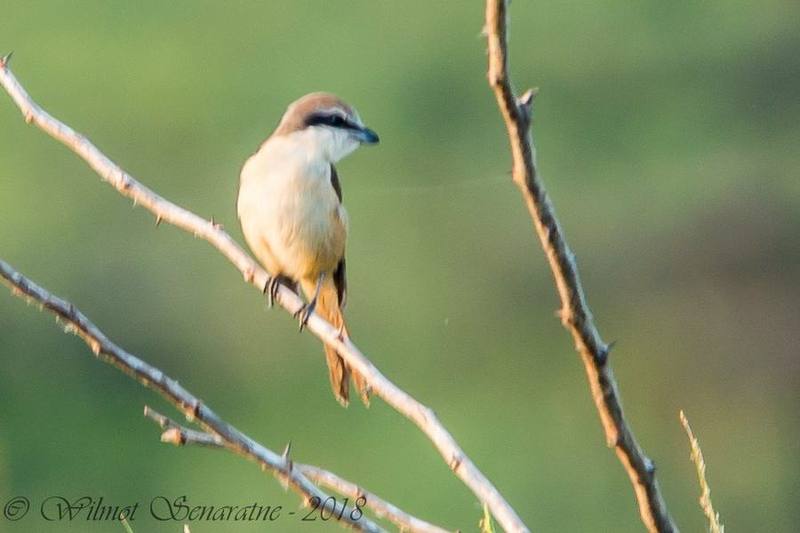
Photo: wilmotsenaratne · CC0 1.0
Lanius schach
Rare visitor: recorded only occasionally in this country
Basic stats
Habitat
Scrub and dry open country
Range
Across Asia, from Kazakhstan to New Guinea
The long-tailed or rufous-backed shrike is a typical shrike with a long, narrow, graduated black tail edged pale rufous, a broad black mask through the eye that covers the forehead, rufous rump and flanks, and a small white patch at the base of the primaries. Plumage varies among its nine subspecies: some have the whole head black, and the grey of the back ranges from pure grey to rufous-tinged. The sexes look alike. The smaller bay-backed shrike is more contrasting with a larger white wing patch (Wikipedia, general species account).
It favours dry, open scrub and perches prominently on bushes or wires. It ranges across Asia from Kazakhstan to New Guinea; temperate populations mostly migrate south in winter, while tropical ones are largely sedentary, making short movements. It forms a superspecies with the grey-backed shrike of the Tibetan plateau. Its genus name means butcher, and its species name imitates its call. SoIB 2023 lists it as resident in India with movements within the country and a very large range, finds its current trend stable, and rates it a Low conservation priority (Wikipedia, general species account; SoIB 2023).
Quick answers
- What habitat does the Long-tailed Shrike live in?
- Scrub and dry open country
- Where is the Long-tailed Shrike found?
- Across Asia, from Kazakhstan to New Guinea
In Vietnam
GBIF holds 701 records of the Long-tailed Shrike from 21 protected areas in Vietnam, dated 1988 to 2026. Most come from Ngoc Linh Nature Reserve and Van Long Nature Reserve.
Where it has been recorded
- Ngoc Linh Nature Reserve 162 records, latest 2024
- Van Long Nature Reserve 146 records, latest 2024
- Bach Ma National Park 80 records, latest 2024
- Bac Huong Hoa Nature Reserve 57 records, latest 2024
- Ba Vi National Park 52 records, latest 2020
- Cuc Phuong National Park 44 records, latest 2026
- Tam Dao National Park 29 records, latest 2023
- Phong Nha-Ke Bang National Park 20 records, latest 2024
Plus 13 more sites.
Covered in our place guides: Van Long Nature Reserve, Bach Ma National Park, Cuc Phuong National Park, Phong Nha-Ke Bang National Park, Da Lat Plateau & Bidoup-Nui Ba, Hoang Lien National Park (Sa Pa).
Seen on trips we host
- Vietnam and Cambodia Liberty-bird Bird Tour Asia, 2009
- Vietnam Bird Tour Asia, 2023
Also in our other guides: India, Malaysia, Nepal, Singapore, Sri Lanka, Sulawesi, Sumatra, Thailand.
Records: GBIF occurrence data matched to park boundaries (© OpenStreetMap contributors, ODbL; Wikidata). Counts show recording effort, not how common the species is.