
 Wildlife
of Vietnam
Little Cormorant
Seabirds & Cormorants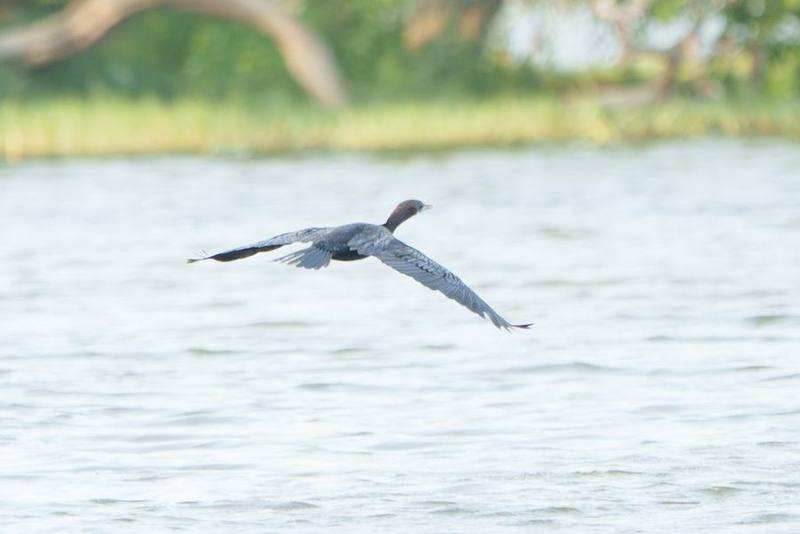
Photo: MATVEY KALACHEV · CC BY 4.0 (May be cropped or resized)
Microcarbo niger
Rare visitor: recorded only occasionally in this country
Basic stats
Diet
Fish
Habitat
Lowland fresh water: ponds, lakes and streams; sometimes estuaries
Range
Indian subcontinent east to Java
Size
About 50cm
The little cormorant is about 50cm long, slightly smaller than the Indian cormorant, with a shorter bill, dark eyes and no peaked head. Breeding adults are glossy black all over with a few white spots and filoplumes on the face and a short crest on the back of the head. Non-breeding birds and juveniles are brownish, with a more fleshy-looking bill and throat skin and sometimes a small white throat patch. The sexes look alike, though males tend to be larger (Wikipedia, general species account).
It forages singly or in loose groups on lowland fresh water, from small ponds to large lakes and streams, and sometimes in coastal estuaries. Like other cormorants it is often seen perched on a waterside rock with its wings spread to dry after fishing. It breeds in colonies in trees, often joining other waterbirds at heronries. In India it is resident across a very large range; SoIB 2023 estimates a long-term increase of about 42% with a stable current trend, and rates it a Low conservation priority (Wikipedia, general species account; SoIB 2023).
Quick answers
- What does the Little Cormorant eat?
- Fish
- What habitat does the Little Cormorant live in?
- Lowland fresh water: ponds, lakes and streams; sometimes estuaries
- Where is the Little Cormorant found?
- Indian subcontinent east to Java
- How big is the Little Cormorant?
- About 50cm
In Vietnam
GBIF holds 298 records of the Little Cormorant from 11 protected areas in Vietnam, dated 1986 to 2026. Most come from Cat Tien National Park and Tram Chim National Park.
Where it has been recorded
- Cat Tien National Park 177 records, latest 2026
- Tram Chim National Park 22 records, latest 2024
- Dong Nai Culture and Nature Reserve 22 records, latest 2024
- Can Gio Mangrove Biosphere Reserve 22 records, latest 2024
- Da Lat Plateau & Bidoup-Nui Ba 16 records, latest 2024
- Yok Don National Park 15 records, latest 2023
- U Minh Thuong & U Minh Ha 8 records, latest 2024
- Lang Sen Wetland Reserve 5 records, latest 2024
Plus 3 more sites.
Covered in our place guides: Cat Tien National Park, Tram Chim National Park, Da Lat Plateau & Bidoup-Nui Ba, Yok Don National Park, U Minh Thuong & U Minh Ha.
Also in our other guides: India, Nepal.
Records: GBIF occurrence data matched to park boundaries (© OpenStreetMap contributors, ODbL; Wikidata). Counts show recording effort, not how common the species is.