
 Wildlife
of Vietnam
Lesser Adjutant
Storks, Herons, Ibises & Pelicans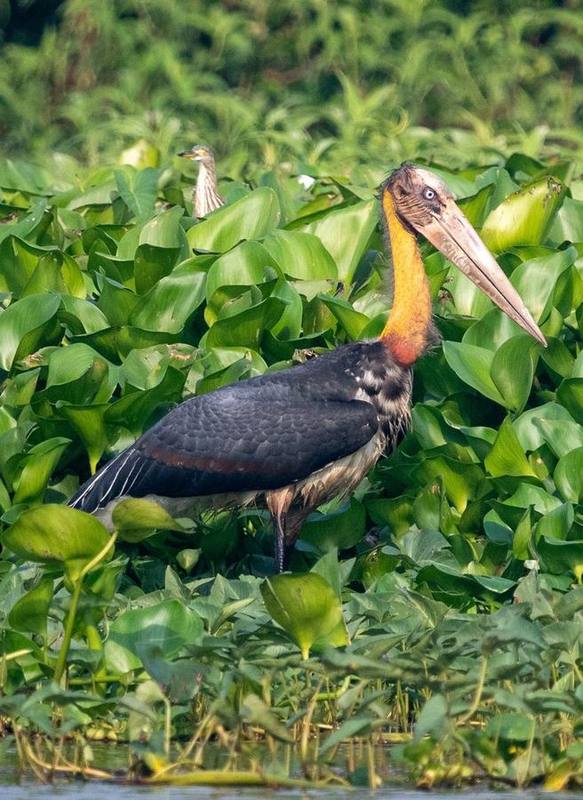
Photo: Stefan C · CC0 1.0
Leptoptilos javanicus
Rare visitor: recorded only occasionally in this country
Basic stats
Habitat
Rivers and lakes in wooded country, freshwater wetlands in farmland, mudflats and mangroves
Range
India through Southeast Asia
Size
87–93cm long; 110–120cm tall
Weight
4–5.71kg
The lesser adjutant is a large stork with an upright stance and a bare head and neck, with a few hair-like feathers but no hanging pouch. It is 87–93cm long, stands about 110–120cm tall and weighs 4–5.71kg. It is smaller and trimmer than the greater adjutant, with a straight upper bill edge, a paler skullcap, almost all-black upperparts and a white belly and undertail; the upper legs are grey rather than pink. In the breeding season the face turns reddish and the neck orange. Juveniles are duller (Wikipedia, general species account).
It is more closely tied to wetlands than the greater adjutant, living around large rivers and lakes in wooded country, freshwater wetlands in farmland and coastal mudflats and mangroves. It is usually solitary and less likely to scavenge than its larger relative. Like other adjutants it flies with its neck retracted. SoIB 2023 lists it as resident in India with local movements, finds a current decline of about 3% a year, and rates it a Moderate conservation priority (Wikipedia, general species account; SoIB 2023).
Quick answers
- What habitat does the Lesser Adjutant live in?
- Rivers and lakes in wooded country, freshwater wetlands in farmland, mudflats and mangroves
- Where is the Lesser Adjutant found?
- India through Southeast Asia
- How big is the Lesser Adjutant?
- 87–93cm long; 110–120cm tall
- How much does the Lesser Adjutant weigh?
- 4–5.71kg
In Vietnam
GBIF holds 487 records of the Lesser Adjutant from 2 protected areas in Vietnam, dated 1984 to 2024. Most come from Cat Tien National Park and Yok Don National Park.
Where it has been recorded
- Cat Tien National Park 482 records, latest 2024
- Yok Don National Park 5 records, latest 2021
Covered in our place guides: Cat Tien National Park, Yok Don National Park.
Also in our other guides: India, Nepal.
Records: GBIF occurrence data matched to park boundaries (© OpenStreetMap contributors, ODbL; Wikidata). Counts show recording effort, not how common the species is.