
 Wildlife
of Vietnam
Hodgson's Frogmouth
Nightjars, Frogmouths & Swifts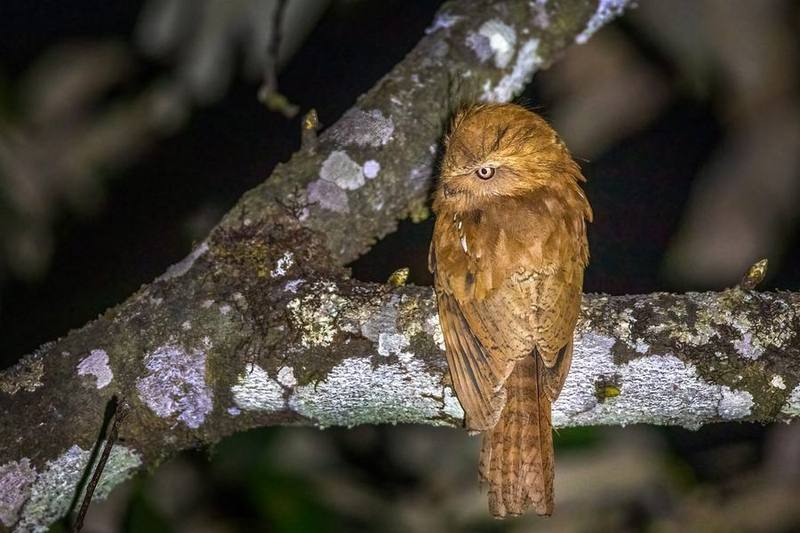
Photo: (c) egorbirder, some rights reserved (CC BY) · CC-BY (May be cropped or resized)
Batrachostomus hodgsoni
Rare visitor: recorded only occasionally in this country
Basic stats
Diet
Mainly insects
Habitat
Forest; arboreal
Range
Bangladesh, Bhutan, China, India, Laos, Myanmar, Thailand, Cambodia and Vietnam
Hodgson's frogmouth is a frogmouth, a bird of the same group as the nightjars. Frogmouths differ from nightjars in having heavier bills, shorter and more rounded wings and an upright posture when perched. The male is rufous brown and is duller than the female, since males incubate by day. It is best identified by its call, as it hardly differs from other frogmouths except in slight colour variation (Wikipedia, general species account).
It is found in Bangladesh, Bhutan, China, India, Laos, Myanmar, Thailand, Cambodia and Vietnam. Frogmouths are non-migratory, solitary birds that meet only in the breeding season, which in the Indian region is between April and June. They are nocturnal and exclusively arboreal, use rictal bristles to sense insects as they hawk, and live on a mainly insectivorous diet. Chicks hatch with white down, later replaced by darker grey down before the juvenile plumage. SoIB 2023 lists it as a resident forest bird that eats invertebrates, and does not assign a priority category (Wikipedia, general species account; SoIB 2023).
Quick answers
- What does the Hodgson's Frogmouth eat?
- Mainly insects
- What habitat does the Hodgson's Frogmouth live in?
- Forest; arboreal
- Where is the Hodgson's Frogmouth found?
- Bangladesh, Bhutan, China, India, Laos, Myanmar, Thailand, Cambodia and Vietnam
In Vietnam
GBIF holds 50 records of the Hodgson's Frogmouth from 3 protected areas in Vietnam, dated 2005 to 2024. Most come from Bach Ma National Park and Da Lat Plateau & Bidoup-Nui Ba.
Where it has been recorded
- Bach Ma National Park 33 records, latest 2024
- Da Lat Plateau & Bidoup-Nui Ba 12 records, latest 2024
- Ngoc Linh Nature Reserve 5 records, latest 2020
Covered in our place guides: Bach Ma National Park, Da Lat Plateau & Bidoup-Nui Ba.
Seen on trips we host
- Vietnam Rare Primates Trip Report, April 2025: Royle Safaris Royle Safaris, 2025
- Vietnam scheduled Bird Tour Asia, 2018
Also in our other guides: India.
Records: GBIF occurrence data matched to park boundaries (© OpenStreetMap contributors, ODbL; Wikidata). Counts show recording effort, not how common the species is.