 Wildlife
of Vietnam
Vietnam’s rare primates in April 2025: doucs, Delacour’s Langurs and Cat Ba Langur
Trip report by Royle Safaris · April 2025
During the wonderful northern hemisphere spring time, Royle Safaris once again ran our Vietnam’s Rare Primates Tour. This trip ran with 5 people booked and once again focused on nearly all of the rare and endemic primate species of Vietnam. The trip was once again led by our great local guide Luc and was successful in nearly all species which were targeted being seen.
This trip report is largely taken from one of our clients (John Weir) and his trip report post on Safaritalk.net (used with his permission).
We run this trip annually at the same time of year (1-16 April) and have some places still available for our 2026 departure if anyone is interested in visiting Vietnam, seeing some of the world’s rarest and most incredible looking primates and also a whole host of other wildlife. We get more and more mammal species on these trips, our most recent success being finding a very reliable place for the Annamite muntjac and we are have once again found reliable sites for southern pygmy slow loris (after a few years of this species being tough). So each year we are expanding what is possible in Vietnam and hope that some of you maybe interested in visiting in 2026. If you are, just contact us on info@royle-safaris.co.uk.
The following report is largely taken from John Weir’s post on Safartalk.net.
During April this year my wife and I spent 16 days on a group tour in Vietnam searching for several primate species. The trip 'Vietnam Rare Primates Tour' was organised by Royle Safaris (UK). Royle Safaris specialise in trips to observe some of the rarest mammals in the world, and their trips have a very good sightings success record. This was the first time we had travelled with them. The trip was a great success, with just 3 other like-minded participants, outstanding guiding and generally good accommodation and food. For an in-depth insight into Vietnam's wildlife and culture I would suggest reading @inyathi's excellent trip report on this site 'Venturing into Vanishing Vietnam' which covers in detail his experiences and thoughts on a mainly birding trip which also includes details of several primate species sightings. Our trip would focus almost exclusively on mammals (mainly primates), although numerous bird species were also recorded.
Two extensions to the main itinerary were also on offer, to try for sightings of a) the Tonkin Snub-nosed Monkey and b) the Cat Ba Langur. (Both species are critically endangered). We decided against a) after Martin Royle and trip reports indicated it was a hard trip, we did however opt to include option b). Snub-nosed Monkeys are truly amazing and we would have loved to have seen them, but a different Snub-nosed species is at the moment much easier to observe in S.W. China, so we would consider that at some stage in the future.
Note from Martin Royle: It is worth noting now that we believe to have found a much easier way of observing Tokin Snub-nosed Monkeys and will be visiting this location in November 2025. So it may be possible to see this species without the difficult hiking.
A growing interest in primates fuelled our decision to move this trip up our wish list, research showed that Vietnam is home to at least 25 species of primates, with one species having two sub-species. Three species are endemic and most are critically endangered, some being dangerously on the verge of complete extinction. However, I was fairly confident that on a trip of this nature sightings of at least 15 species were possible with a good guide. I would echo the views of others, if you are looking for 'wall to wall' wildlife particularly mammals then Vietnam is probably not for you, but if you are prepared to work hard sightings of some of the rarest mammals (primates) in the world are possible.
The country itself is wonderful, the scenery particularly in the north is stunning unlike anything we have seen before and the people we met were always friendly and helpful.
ITINERARY:
Day 1: Moved to the group hotel in Ho Chi Min City, Mount Thanh Grand Hotel. Very good hotel and food. Met the team leader and the other 3 participants. We discussed targets etc. The group consisted of a German guy and another UK couple. We all got on well throughout the trip, the group size was ideal (5). It was decided that we would only try for sightings in truly wild settings.
Day 2-4: Cat Tien N.P. Guest House (Eco Resort). Basic but clean, food good. Day and night walks and drives. Crocodile Lake hike.
Day 5: Flight from Ho Chi Min City to Danang (Da Nang). We were due to stay in Nui Thanh district, but instead stayed in a good hotel in Danang. Grand Gold Hotel, very good.
Day 6: Grey-shanked Douc location. Grand Gold Hotel.
Day 7-8: Son Tra Reserve and then drive to Bach Ma N.P. Guest House (Eco Resort in the park). Accommodation tired and basic, food OK. This was the only accommodation on the trip we had concerns about. The property was not well maintained. Day and night walks.
Note from Martin Royle: This is the only accommodation inside the national park and only by staying inside the park are you allowed to explore the park day and night to its fullest.
Day 9: Bach Ma N.P. (am), then drive to Phong Nah N.P. Guest House (Eco Resort). Accommodation very good, food also, but even better in town at Bamboo Chopsticks Restaurant, we ate there 3 times. Would recommend.
Day 10-11: Phong N.P. as above. Day walks and drives.
Day 12: Travel to Ninh Minh. Van Long Green Hotel. Very good accommodation and food. Late afternoon in Cuc Phuong N.P., including extended night walk.
Day 13-14: Van Long Reserve, boat trip, afternoon walk around the reserve and extended night walk in Cuc Phuong N.P.
Day 15: Travel to Cat Ba Island. Afternoon private boat trip. L'Heritage Diamond Hotel and Spa. Food average, accommodation good.
Day16: Early morning boat trip. Drive to Hanoi where the trip ended.
The food throughout was great, we would benefit from some chopsticks practice however. Malarone (anti-malarial) was taken but was possibly not essential. Very few insect bites, not really an issue. AC and hot showers at all locations, which was vital. Weather, hot to very hot, mainly dry with a couple of light showers and it was extremely humid. We had comfortable private transport for our group throughout the trip. Our guide was Luc, was with us for the whole trip. He was excellent, he worked very hard at all times to secure sightings, he managed and led the trip very professionally. Essentially he is a birding guide with a very real interest in mammals, particularly primates and knows how and where to find them. He was a pleasure to be with. He has led several Tonkin Snub-nosed Monkey extensions all with a success rate of 100%. Both Luc and I used night vision scopes on all the night walks.
This trip report will highlight mammal sightings (particularly primates) observed at each location visited in Vietnam and also includes a few bird images as well (all images are after the text in this report). Photography on this trip proved difficult. Several species were only observed from a considerable distance, binoculars were vital and one participant had a spotting scope which proved invaluable. Primates at the best of times are not easy subjects, either to locate or photograph, they tend to be nervous and fast moving. In Vietnam all wildlife demonstrated a very real fear of any (even distant) human presence. Primates were also often located in the forest canopy with very poor light conditions, some species are only found in cloud forest habitat which isn't ideal for photography either. For really distant shots I used my lens at 500mm with a 1.4X extender and the camera cropping/aspect ratio set at 1.6X (crop), even then reach was a struggle, so many images posted here are regarded as record shots, but nevertheless, they feature very rare species so are included in this report. To us it is the sighting that counts, just sitting watching a family of primates even from a considerable distance knowing that there possibly are only a small number of individuals remaining in the wild is a very special and privileged moment, not to mention a very sad one too.
CAT TIEN NATIONAL PARK
1. LONG-TAILED MACAQUE (OFTEN REFERRED TO AS CRAB-EATING MACAQUE). ENDANGERED.
This was our first primate species recorded in Cat Tien N.P. On our first afternoon drive a troop of around 12 individuals including adults with young, quickly crossed the track and climbed into some trees, they were very nervous and vanished into thick forest . Images were not possible, the sighting was brief and was over quickly. These were of the nominate sub-species (grey form), which we had seen in Borneo in 2024. This species was not seen again on the trip, they are apparently commonly seen in the park. An additional subspecies (disputed) is found on Con Son and Hon Ba Islands off the coast of southern Vietnam.
2. BLACK-SHANKED DOUC. CRITICALLY ENDANGERED.
This species was seen virtually every time we went out, unfortunately they always appeared well hidden and were usually in the high canopy. The best time was from 06.00 to 10.00. We saw several family groups and all were very nervous moving off at speed as we got anywhere near. This species was only seen in Cat Tien N.P. on this trip.
3. SOUTHERN YELLOW-CHEEKED GIBBON. ENDANGERED.
Relatively common in the park in small family groups, seen each day only between the hours of 06.00 t0 10.00. They seemed to come in to the rehabilitation facility near the visitor centre every morning to claim food, we avoided this and located groups that appeared to be feeding naturally. This often involved long walks in the forest following their unique calls, they are very vocal during this early morning period so are relatively easy to locate. Listening to their calls in the forest is a very unique and special experience, rather like Indri in Madagascar. This species was only seen in Cat Tien N.P. on this trip.
4. NORTHERN PIG-TAILED MACAQUE. VULNERABLE.
Only seen in Cat Tien N.P. early one morning a small troop was seen near park HQ. This was a new species for us, we had seen the southern species in Borneo. Unfortunately no image available, once again they were extremely nervous, so the sighting was brief.
CROCODILE LAKE HIKE.
One morning we decided to do the walk out to Crocodile Lake, mainly to try for more Langur sightings. From where we parked up I made it 6 km each way. The walk was in the main through a dense forest on a good path, it was generally flat with some uphill sections. We were in the shade for most of the time, I had heard the walk described as being easy but we found it far from that due to it being very hot 35°C, despite setting off early, and the humidity was very high, 95%. Hence we were all soaking apart from Luc when we eventually arrived at the lake. It took us around 2 hours each way, stopping frequently for mainly bird sightings. We ate at the lake cafe and had a 2 hour rest before re-tracing our steps. Crocodile Lake is the home to a population of Siamese Crocodiles (CRITICALLY ENDANGERED) which at one time were very common throughout S.E. Asia but have been extirpated from most of their range, including Vietnam. Apparently there are thousands on crocodile farms but most are not genetically pure having been crossed with Saltwater Crocodiles. So in 2000, 60 genetically sound individuals I think from Cambodia were released in the lake. They have been allowed to breed naturally and
the current population stands at around 200. Poaching for their skins unfortunately still remains a problem. There are plans to move some eventually to other sites in Vietnam.
The walk back was uneventful but exhausting. We did a night drive and walk in the evening. Small Indian Civet. ssp thai, again briefly seen in pasture at night initially picked up using thermals. Using a thermal throws up lots of bird sightings at night, I initially had this listed as a Hainan blue flycatcher, on reflection it looks more like a White-throated rock-thrush (male).
The following morning 2 of our group went to the central bird hide and had good sightings of Scaly-breasted Partridge (Green-legged (Hill) Partridge ssp.cognacqi) and Germain's Peacock Pheasant. Three of us went in search of the Silvered Langur which we didn't find, but also saw some interesting birds. On our return to the lodge we had breakfast and left for a 1.5 hour flight to Danang from HCMC and hopefully some more primate sightings.
Other mammals recorded in Cat Tien N.P. but not mentioned in the text: Sambar, Northern Red Muntjac, Pallas's Squirrel (southern ssp), Cambodian Striped Squirrel, Lesser Short-nosed Fruit Bat, Common Palm Civet, Annamese Sliver Langur (only sounds, movement, one person saw a quick view of tail), not seen well enough to include on the primate list and Indochinese Ground Squirrel and Northrn Treeshrew (both these species were not seen by all).
We arrived in Danang early evening and drove to our hotel near the city centre, we were due to stay in a guest house in Nui Thanh District near the location for possible Grey-shanked Douc sightings but moved to this modern hotel instead, we were not entirely sure why, however everyone was fine with the change as the hotel was excellent with great facilities and food.
TAM MY TAY COMMUNE. (NUI THANH RESERVE).
The following morning we left early and after a 1.5 hour drive arrived at Tam My Tay Commune (Nui Thanh District, Huang Nam Province) around 07.30. The walk in to the sighting area was relatively easy (1.5 km) with a couple of streams to cross. Then the walk became more challenging, initially we followed a steep track up into the hills and then scanned for about 30 minutes without any luck. We then dropped back into the valley and then climbed up into the forest for about 1 km, this was very steep and hard going, wet and slippery, after about 30 minutes we stopped and spent an hour scanning an adjacent hillside, again with no luck. Luc, our guide from high up in an acacia plantation scans the adjacent isolated forest for Grey-shanked Douc.
By now it was 11.30, unbelievably Luc who had returned to the group after recceing the area for an hour without success took lunch orders, he then rang our driver, who went to a local village, got the food and walked in with it. So at 13.30 having dropped back into the valley and climbed into an acacia plantation we enjoyed a warm lunch of chicken and rice. But still no Doucs. Eventually around 15.00 just as we were about to admit defeat, movement was spotted in a tree across the valley around 350 metres away. Eventually a group of at least 7 Grey-shanked Douc could just about be seen with the naked eye, however clearly in binoculars and the scope. There appeared to be some youngsters as well although they were particularly hard to see.
5. GREY-SHANKED DOUC. CRITICALLY ENDANGERED. ENDEMIC.
Several organisations are working in the area to both protect and preserve the species. Only circa 1500 remain in the wild in isolated pockets in the Central Highlands, a new group was discovered as recently as 2016, lack of movement corridors between the isolated groups is a real problem. In this particular area there are around 70 adults in several groups, this is a 40% improvement on the 2019 figure. In this location the once large tracts of cloud forest have been cleared for agriculture and timber production, namely introduced acacia plantations, which is useless habitat for Doucs. This and the hunting for bushmeat, traditional medicine and the pet trade are responsible for the demise of the species. Although the forest was quite large and looked healthy, it was completely surrounded by acacia plantations. The area can only support a limited number of individuals and groups. The long term future of this species worries me. We watched the group for around an hour. Walking out my wife noticed the sole on one of my boots had come loose, not good as we would be doing quite a lot of walking in damp conditions my solution was super-glue, we would need to stop tomorrow to get some.
We arrived back at our hotel around 18.30 well satisfied after a strenuous but successful wildlife experience.
The following morning we headed for Bach Ma National Park, via Son Tra Reserve which is situated about a 20 minute drive from Denang.
SON TRA RESERVE (sometimes referred to as Monkey Mountain).
Just as we entered the reserve about a 100 metres in front of us a group of Red-shanked Douc crossed the road and a few remained in a tree 20 metres from the roadside, briefly.
6. RED-SHANKED DOUC. CRITICALLY ENDANGERED.
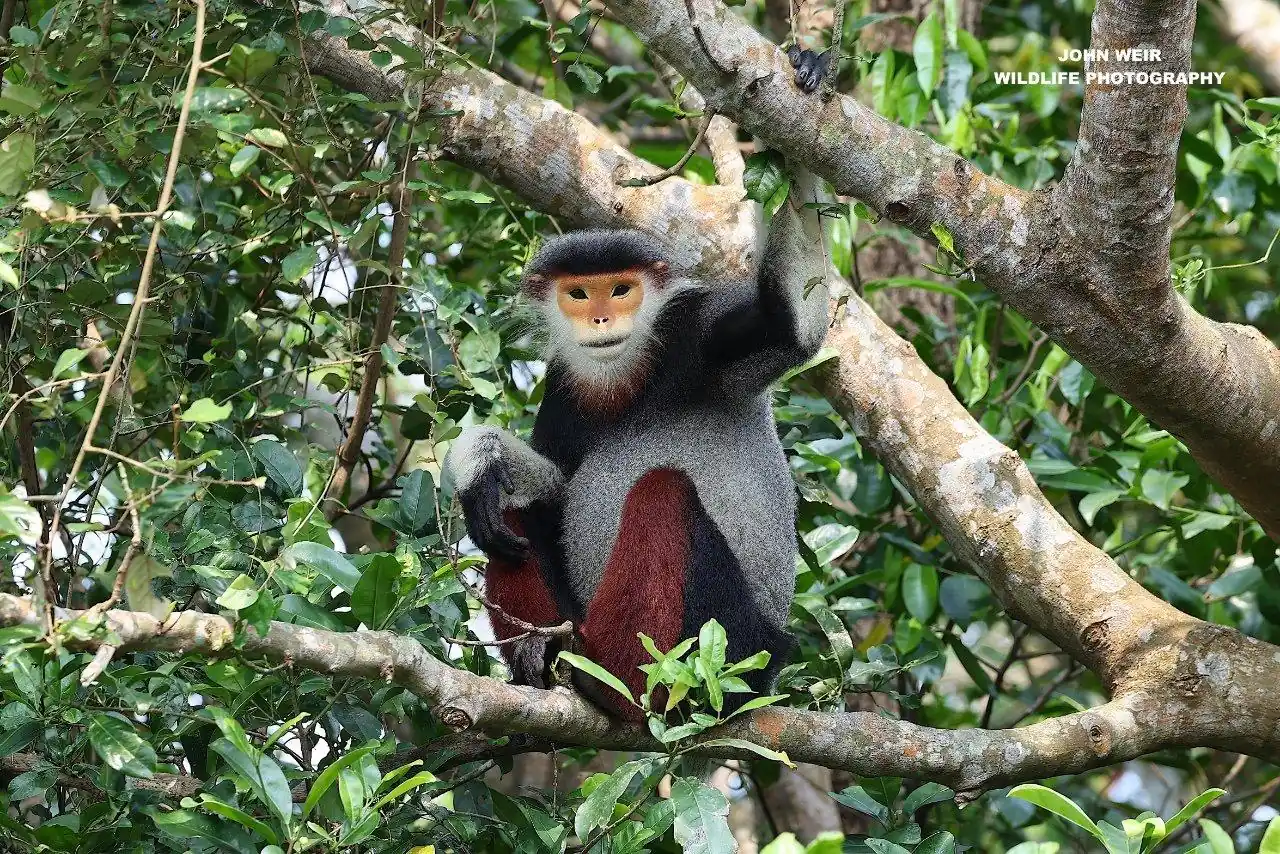
This wonderful species was exactly why we were in Vietnam. They were even more impressive in the wild than in the documentary that sparked my original interest in Vietnam. Wow! One of those wildlife moments we will never forget. Surely one of the most impressive and beautiful primate species. One large male stayed in the open for several minutes although a female was attracting his attention. Another adult eventually came into view. After few minutes they all climbed into a tree and quickly disappeared. We were the only group at the sighting. There are approximately 1500 Red-shank Doucs in and around Son Tra Reserve, it is possibly the best location to visit if this species is on your wish list. We also saw them in Bach Ma and Phong Nah, but never as well as this. They are certainly not as endangered as the Grey- shanked Douc, but nevertheless numbers remain low.
As we turned to leave the reserve a large troop of Rhesus Macaques were spotted in a roadside clearing. Another species for the growing list.
7. INDOCHINESE RHESUS MACAQUE. LEAST CONCERN.
I was amazed at how calm the large troop was (40+), unlike their Indian relatives which can be quite aggressive towards humans, particularly with regard to food. This sighting attracted quite a crowd including noisy children with ice cream but the Macaques behaved.
We left Son Tra Reserve and headed for Bach Ma National Park. As we passed through Danang, we stopped and Luc and I got out, he led me to a guy sat on the pavement who was repairing shoes, he hand stitched my sole back on in 5 minutes, the repair lasted the rest of the trip and is still going strong $3!, he got more. Who needs super glue! A very good day so far.
No additional mammals spotted at the last two locations.
We stopped to get fresh fruit for our stay in Bach Ma, Luc's niece had joined us for the rest of the trip to gain some work experience, she was very helpful and well liked by the group.
I should have mentioned in my previous posting that although the Red-shanked Douc is critically endangered we did see the species at 3 different locations and in quite good numbers on this trip. The critically endangered classification (2020) was based on the speed of the decline in their numbers in recent years. It is also found in Laos and possibly Cambodia. The Black-shanked is found also in eastern Cambodia, whilst the Grey-shanked is endemic to Vietnam and as previously mentioned this species is in real trouble.
BACH MA NATIONAL PARK
This park for us was the real disappointment of the trip. We spent 2 nights here and saw very little it is a large park with lots of potential. A significant part of the park is at altitude so it was cooler here and whilst we were there it was continuously shrouded in mist, making any sightings very difficult. It is however a cloud forest so the conditions were to be expected. We spent most of our time in the park walking forest trails and roads both during the day and at night.
The accommodation was very basic and badly maintained, although the food was quite good. It didn't spoil the trip we are used to taking the rough with the smooth.
Our transport throughout was in a Ford Transit minibus, for a group of 5 there was plenty of room, a double seat each. Possibly if we hadn't stayed inside the park, walking at night in the park may not have been allowed. (Some sort of nighttime activity at the moment is an imperative for us).The park guest house where
@inyathistayed is now closed, ours was about a 5 minute drive further down the main road towards park HQ. Facilities in the park have been neglected and are very much in need of attention, there was some signs of remedial work taking place.
ANNAMITE MUNTJAC (TRUONG SON MUNTJAC) Muntiacus truongsonensis ENDANGERED. (Data deficient).
On the second night (22.35) we briefly from distance had a sighting of this rarely seen Muntjac species. They are very small about half the size of an Indian Muntjac and were only discovered in 1997. They are only found in the Annamite Mountains of Vietnam and Laos, in dense forests and at altitude, usually in remote locations away from villages, hunting pressure may influence remoteness. They are rarely seen, so this was a special sighting. Also on the same walk we had a good but brief sighting of a Hodgson’s frogmouth, which we both enjoyed as we are very interested in Nightjars and their allies and a Lesser mouse-deer, which we had seen before in Borneo.
Red-shanked douc, was also seen in Bach Ma when the visibility improved briefly, we would not enjoy another Son Tra N.P. experience on this trip.
Oriental garden lizard and another notable reptile sighting in the park was a sub-adult (black phase) reticulated python. Circa 1.6m. Black background colour with normal yellowish diamond shaped blotches. Possibly an adaptation to living at altitude in a coolish climate, it was very aggressive.
During our time in the park we climbed to the highest point 1450m's, this peak saw heavy fighting during the Vietnam War, the surrounding area has several reminders of the awful conflict.
Other mammals seen here were Variable Squirrel (not seen by all) and Red-cheeked Squirrel.
From Bach Ma we headed to Phong Nha N.P, leaving around 09.00.
PHONG NHA NATIONAL PARK
As we turned off the road after a 4.5 hour drive it became immediately apparent that we were entering an area of outstanding natural beauty, unlike anything we had ever experienced before. It hit us just like our first visit to the Grand Canyon, it was spectacularly beautiful, it just took our breath away. Never mind looking for primates this was a location you just wanted to explore in detail, but unfortunately, we had very little time to do that. We have experienced limestone (karst) scenery before but never on this scale, huge limestone pinnacles covered in dense forest, absolutely magnificent, it just didn't seem to matter if our primate targets were realised it was just a privilege to be there. The town of Phong Nha is on just about every backpacker's wish list and has developed quite rightly to cater for that demand. However, it was a very pleasant place to be, with excellent restaurants, a lively but not rowdy feeling and it gave us the opportunity to talk to young people from all over the world. The park is the home to some of the most comprehensive underground cave systems in the world and most backpackers were there to explore them at an appropriate level, easy to severe. The more severe trips spending several days underground are often booked up a year in advance and require a very high degree of fitness. As an ex-caver, I started wishing I could turn back the years. Anyway, I digress, we were there for two primates both of which would be difficult, a Langur and a Gibbon. The chances of seeing either in the park were described as being slim and that they were hard to find, so optimism was low. However the chance of a Langur sighting was virtually guaranteed if we visited a fenced rehabilitation facility (near Tro Moong Ranger Station) which closed several years ago and has since fallen into disrepair, however several Langurs have remained in and around the facility. Wild or not wild, semi wild, we decided against it , we would spend our time trying for a completely wild sighting in the forests, even if it meant being unsuccessful.
This was where we stayed, it was very comfortable, in the main we ate at a restaurant in town, the food there was excellent. The weather here was very hot so the pool got plenty of use. The owners' dogs tended to get in as well. Quite an unusual experience, swimming with dogs. Langurs are often seen in the forest behind the lodge but not on this trip. What we tended to do whilst here was an early morning and late afternoon drive / walk, each of at least 4 hours duration.
8. HATINH LANGUR. ENDANGERED. POSSIBLY ENDEMIC, may also be found in Southern Laos.
As predicted we struggled with this species, although on our first morning one shot across the road about 100 m's in front of our vehicle, only the briefest of sightings. Then on the 2nd morning at 07.15 well inside the park Luc spotted one in tree about 50 metres from the road.
9. STUMP-TAILED MACAQUE. VULNERABLE.
As we returned to our lodge after the Langur sighting a troop of Stump-tailed Macaques were observed about 150 m/s in front of the vehicle sat on the road. There were around 8 and as we braked they quickly vanished into dense vegetation, so an image was not possible. However I did get a good view of them and was amazed at how stocky they were, several had bright red faces. Quite an intimidating primate, but once again very nervous. They remained active and noisy but out of sight as we got close to them. Also seen here was Tenasserim White-bellied Rat. The call of the southern white-cheeked gibbons were heard and there was movement seen, but not enough to call it a sighting.
After an early morning unsuccessful drive and long walk we headed for Van Long Reserve and after a long drive arrived at our destination after dark. Long road transfers are often very interesting as you get a real feel for the country you are visiting , this was the case in Vietnam. After a quick evening meal we headed out to Cuc Phong N.P. which was about an hours drive away.
CUC PHONG NATIONAL PARK
We visited this park on both nights we were in the area and despite lengthy walks our target primate was not realised, the Pygmy Slow Loris, we had also tried hard for this species in Cat Tien N.P. The only mammal seen during our 6 hours of night walks here was a Javan Mongoose, which crossed the track at speed on the second night around 23.15. Despite using thermal scopes here only a few resting birds were recorded. Probably the most mammal deficient habitat we have ever explored, strange really as some of the forest is pristine. We explored a cave here which was home to a large colony of Great Roundleaf Bats and encountered a cobra sp. in long grass at night which focussed the group for the rest of the evening.
Cuc Phuong N.P. appears to be running several rehabilitation / conservation programmes which I cannot comment on as we were never there during the day.
Our base for 2 nights it a was very comfortable hotel in Van Long and the food was good, what was even more important was that it was only a 2 minute walk to the start of one of the most magical wildlife viewing experiences we have ever enjoyed, the Van Long boat trip, to try for Delacour's Langur. We left the hotel at 08.00 and were on our boat within minutes.
General view of Van Long Reserve, the boats we used are in the foreground, it is a Ramsar site, so birding was pretty good, the site includes the limestone (karst) cliffs in the background. The site is quite extensive but urban development is starting to encroach along most of its' borders. The reserve should be protected at all cost.
Once we got a sighting of the Langurs the sighting was so good Luc (our guide) for the first time on the trip produced his camera!
10. DELACOUR' S LANGUR. CRITICALLY ENDANGERED. ENDEMIC.
The population of Delacour's Langurs at Van Long Reserve is possibly the only viable population in Vietnam, there are around 175 individuals here. (Data from recent drone survey). Other much smaller populations remain outside the reserve, are isolated and do not have good breeding potential. The total population count remains debatable at between 210 and 250. They are one of the rarest primates in the world and were until recently always included on the 'Primates in Peril List', certainly in recent years numbers have not increased significantly, so I am not entirely sure why they have been removed from the list. They are a terrestrial Langur associated with karst limestone cliffs and have adapted to live in this unique habitat. We fell lucky during our visit and observed well 4 families (troops) represented by 50 individuals and encouragingly 3 babies.
In the afternoon we drove around to one side of the reserve and then walked, we were lucky enough to engage with 2 more family groups, bringing the number of families seen to 4. The afternoon sightings were from distance but individuals could be clearly observed and identified. Only 15 adults seen compared to 35 in the morning.
After the afternoon walk we drove around the back of the reserve and were appalled to see that whole limestone cliffs were being mined very close to the Langur habitat for use in the huge local cement factory. I am very concerned about the long term future of this wonderful primate species. I just hope there is a will to save this species as it is right on the brink of extinction at the moment. They are still being poached for bushmeat and traditional medicine!
The best time to observe the Langurs is early morning (08.00+) and late afternoon (16.00+).
The mid afternoon shift, most Vietnamese tourists seemed to just enjoy a trip out on the lake, oblivious to the Langurs found on the cliffs behind and most didn't appear that interested. We came across only one wildlife enthusiast, during our stay here.
It was interesting that during the day several ladies were observed in the lake, harvesting freshwater clams it seemed like very hard work.
In the morning before we left Luc went out early and eventually found a small group of Macaques high up on a cliff. I had mentioned several times that I was keen to see this species so Luc had hired a scooter for a couple of hours and searched the full length of the cliffs until he found them. Great guiding.
11. ASSAMESE MACAQUE. NEAR THREATENED.
Four Assamese macaques with their backs to the camera seen from a considerable distance. The spotting scope came in handy here. We would also see this species at our final location, however again not particularly well. We have seen this species before much better in Kaziranga N.P. Assam, India.
CAT BA NATIONAL PARK
This would be our final location for the trip, it was a trip extension so came at an additional cost which proved to be money well spent. We arrived at the ferry terminal at 11.30 it was relatively quiet so we got straight on a ferry and the crossing to Cat Ba Island took about 35 minutes. Our crossing was from Dong Bai (Cat Hai Island) to Cat Vieng (Cat Ba Island), Cat Hai is reached by a causeway from the mainland. Apparently in the high season ferry queueing time can take up to 3 hours. Cat Ba Island is an extremely popular tourist destination due to it being situated on the southern edge of Vietnam' s famous Ha Long Bay, an area of outstanding natural beauty. The ferries run every 30 minutes and hold approximately 30 cars and numerous foot passengers.
We had one night on the island close to Cat Ba Town and would take 2 private boat trips one in the afternoon of our arrival and one early the following morning before we departed for Hanoi where our tour would end. Our time in the national park would be spent exclusively at sea in the marine section of the park which gives visitors the best chance of a primate sighting. The coastal area around Cat Ba Town was filled with literally hundreds of boats both large and small taking tourists around the bay famed for its outstanding natural beauty consisting of numerous limestone pinnacled islands which seem to go on forever. It really is spectacular and should be on every traveller's wish list. 99.9% of visitors were here for a few beers and a cruise around the bay, we however were here mainly for something completely different, if possible a sighting of one of the rarest mammals/primates in the world. We met no other wildlife enthusiasts during our brief time on the island.
The world famous floating fishing villages, it is reported that some people are born and die here having never set foot on dry land. (possibly folklore). You can actually stay overnight on one of these pontoons, which we both fancy doing at some stage in the future. We would have loved to have had more time in this area.
The spectacular scenery just went on and on, we however were honing in on one particular island peninsula and cove which occasionally provides at this time of day primate sightings, which incidentally are not guaranteed.
12. CAT BA LANGUR. CRITICALLY ENDANGERED. ENDEMIC.
Luc (guide) seemed quite confident that he could locate a Cat Ba Langur as he was aware of the territories of several langur families. As we headed close to the coast it was apparent that all the other sightseeing vessels were not following our route, we bumped into a small boat being driven by a park ranger and he asked us to hide our cameras, in an attempt not to attract in other boats. Eventually we entered a small cove and on top of some high cliffs we spotted our first Cat Ba Langur.
This is possibly the rarest species to have ever been posted on this platform. For many years this species has featured in the "Primates in Peril" list (which lists the world's 25 most endangered primates and it is included in the 2023-25 list) and is currently regarded by many as the rarest and most endangered primate in Asia. Current developments on the island do not bode well for its long term future. In the 1960's the population on the island and some of the smaller islands was believed to be around 3,000 individuals, by 2000 that number had dropped to 40+. Yes only the low 40's. In 1986 the park was formed and by 2006 the population with some protection had risen to 64. The main threat to the species continues to be the usual culprits, hunting for sport and traditional medicine and habitat loss due to the island's increased tourist numbers. Poaching was a significant problem particularly in 2016 when 17 went missing which at the time represented 25% of the total population. Since the beginning of 2024 15 babies have been born which is the largest population increase in the last 20 years. The limestone (karst) cliffs are far more exposed and sheer than
those at Van Long but the langurs seen were all expert climbers superbly adapted to their challenging environment. The 2024 census conducted by drone suggested a population of around 90 individuals including babies and juveniles. Like other langurs the young are born brown and change to their adult colouration during the first couple of years. Luc our guide, although he had not been to Cat Ba for 12 months knew exactly where to locate the langurs.
The following morning we went out early and again had success, before we found the langurs we had a brief sighting of a small troop of Macaques.
Notes from my field book, as written:
15/4 Afternoon boat trip 15.00 - 18.00, first langur seen around 17.00. In total 5 langurs seen from distance, on cliff tops and faces. 1 had a baby, 1 had twins and 1 was with a juvenile. We observed them for around 40 minutes before they crossed the cliffs and vanished inland. It was warm and sunny and the visibility was good. Sea choppy, holding the camera still, difficult.
16/4 Morning boat trip. 07.30 - 10.30. 2 groups seen. 1. @ 08.30 & 2. 09.15. 1. Bachelor group of 5 sub-adult males. 2 less than Luc's last visit. Observed for 10 minutes crossing the cliff faces mainly in trees. 2. Adults observed on the cliff faces, the same family as yesterday but with more individuals. 6 adults with 4 babies and 1 juvenile. 2 more than yesterday, 1 adult new possibly the dominant male and 1 new baby. Mild but overcast and poor light, sea very choppy.
16 langurs seen in total, assuming an optimistic population of 90, this number represents 18% of the species total.
Trip data:
12 out of 15 target primate species realised, including 3 of the rarest in the world.
Primates we expected to see but were not located:
1. Pygmy Slow Loris. Apparently getting very hard to locate, we tried hard in several parks but drew a blank, we walked for miles at night using thermal scopes but didn't get a sniff. No regrets we tried very hard. Luc was saying that lots are taken for the pet trade.
Note from Martin Royle: since this trip, we have now found once again reliable sites for this species – which has been split into a southern species and an intermediate species. We put future success rates of sightings for both species at around 80% for the southern species and around 50% for the intermediate species.
2. Annamese Silvered Langur. Luc had a brief sighting and my wife spotted a tail in Cat Tien N.P. whilst walking to Crocodile Lake. Park staff indicated they are hard to find at certain times of the year, certainly not guaranteed on a 3 night stay. Now quite hard to locate used to be more common several years ago.
3. Southern White-cheeked Gibbon. Heard from distance on 2 mornings in Phong Na N.P. and the movement of foliage, but no confirmed sighting.
- 26 species of mammals observed, 21 new to us (includes ssp). Note from Martin Royle – additional species were seen by Luc or others (not all) • 132 species of birds recorded, as usual without trying hard, too busy primate hunting. • 6 species of reptiles recorded.
This was a really enjoyable trip, the Vietnamese people were warm and friendly and the scenery was breathtaking. We would certainly re-visit. Relatively cheap cost of living.
Vietnam is a country on the up, massive infrastructure projects are taking place everywhere, we just hope they find the time and space to protect what wildlife they have left.
The trip represented excellent value for money in this age of ridiculously high wildlife viewing trip costs. We intend to use this operator again.

| Rhesus Macaque | Annamese Macaque |
|---|---|
| Hatinth Langur | Delacour’s Langur |


| Cat Ba Langur | Sambar |
|---|---|
| Northern Red Muntjac | Annamite Muntjac |


| Pallas’s Squirrel | Red-cheeked Squirrel |
|---|---|
| Small Indian Civet | Red Junglefowl |


| Green Peafowl | Red-collared Dove |
|---|---|
| Thick-billed Green Pigeon | Asian Barred Owlet |


| Bar-bellied Pitta | Orange-breasted Trogon |
|---|---|
| White-throated Rock Thrush | Banded Broadbill |


| Dusky Broadbill | Striped-throated Bulbul |
|---|---|
| Hainan Blue Flycatcher | Sultan Tit |


| Necklaced Barbet | Eastern Cattle Egret |
|---|---|
| Siamese Crocodile | Common Garden Lizard |


Species List
Mammals (* = heard or signs only)
Cat Tien NP (CAT) / Nui Thanh (NUI) / Son Tra (STR) / Bach Ma NP (BMA) / Phong Nh NP (PNH) / Van Long (VNL) / Cuc Phong NP (CUC) / Cat Ba NP (CAT)
| Common Name | Binominal Name | CAT | NUI | STR | BMA | PNH | VNL | CUC | CAT | |
|---|---|---|---|---|---|---|---|---|---|---|
| 1 | Pallas's Squirrel | Callosciurus erythraeus | * | |||||||
| 2 | Variable Squirrel | Callosciurus finlaysonii | * | |||||||
| 3 | Lesser Short-nosed Fruit Bat | Cynopterus brachyotis | * | |||||||
| 4 | Red-cheeked Squirel | Dremomys rufigenis | * | |||||||
| 5 | Great Roundleaf Bat | Hipposideros arniger | * | |||||||
| 6 | Stump-tailed Macaque | Macaca arctoides | * | |||||||
| 7 | Assamese Macaque | Macaca assamensis | * | |||||||
| 8 | Long-tailed Macaque | Macaca fascicularis | * | * | ||||||
| 9 | Northern Pig-tailed Macaque | Macaca leonine | * | |||||||
| 10 | Rhesus Macaque | Macaca mulatta | * | |||||||
| 11 | Indochinese Ground Squirrel | Menetes berdmorei | * | |||||||
| 12 | Annamite Muntjac | Muntiacus truongsonensis | * | |||||||
| 13 | Northern Red Muntjac | Muntiacus vaginalis | * | |||||||
| 14 | Tenasserim White-bellied Rat | Niviventer tenaster | * | |||||||
| 15 | Southern Yellow-cheeked Gibbon | Nomascus gabriellae | * | |||||||
| 16 | Common Palm Civet | Paradoxurus hermaphroditus | * | |||||||
| 17 | Red-shanked Douc | Pygatgrix nemaeus | * | * | * | |||||
| 18 | Grey-shanked Douc | Pygathrix cinerea | * | |||||||
| 19 | Black-shanked Douc | Pygathrix nigripes | * | |||||||
| 20 | Sambar | Rusa unicolor | * | |||||||
| 21 | Cambodian Striped Squirrel | Tamiops rodolphii | * | |||||||
| 22 | Delacour's Langur | Trachypithecus delacouri | * | |||||||
| 23 | Hatinh Langur | Trachypithecus hatinhensis | * | |||||||
| 24 | Annamese Silver Langur | Trachypithecus margarita | * | |||||||
| 25 | Cat Ba Langur | Trachypithecus poliocephalus | * | |||||||
| 26 | Lesser Mousedeer | Tragulus kanchil | * | |||||||
| 27 | Northern Treeshrew | Tupaia belangeri | * | |||||||
| 28 | Javan Mongoose | Urva javanica | * | |||||||
| 29 | Small Indian Civet | Viverricula indica | * |
Birds (* = heard or signs only)
Cat Tien NP (CAT) / Nui Thanh (NUI) / Son Tra (STR) / Bach Ma NP (BMA) / Phong Nh NP (PNH) / Van Long (VNL) / Cuc Phong NP (CUC) / Cat Ba NP (CAT)
| Common Name | Binominal Name | CAT | NUI | STR | BMA | PNH | VNL | CUC | CAT | |
|---|---|---|---|---|---|---|---|---|---|---|
| 1 | Great Myna | Acridotheres grandis | ||||||||
| 2 | Vinous-breasted Myna | Acridotheres leucocephalus | * | |||||||
| 3 | Common Iora | Aegithina tiphia | * | * | ||||||
| 4 | Germain’s Swiftlet | Aerodramus germani | * | * | ||||||
| 5 | Fork-tailed Sunbird | Aethopyga christinae | * | * | ||||||
| 6 | Crimson Sunbird | Aethopyga siparaja | ||||||||
| 7 | Common Kingfisher | Alcedo atthis | ||||||||
| 8 | Black-browed Fulvetta | Alcippe grotei | * | |||||||
| 9 | Mountain Fulvetta | Alcippe peracensis | ||||||||
| 10 | Puff-throated Bulbul | Alophoixus pallidus | * | |||||||
| 11 | White-breasted Waterhen | Amaurornis phoenicurus | * | |||||||
| 12 | Golden-crested Myna | Ampeliceps coronatus | * | * | * | |||||
| 13 | Asian Openbill | Anastomus oscitans | * | * | ||||||
| 14 | Oriental Darter | Anhinga melanogaster | * | * | ||||||
| 15 | Oriental Pied-Hornbill | Anthracoceros albirostris | * | |||||||
| 16 | Paddyfield Pipit | Anthus rufulus | * | |||||||
| 17 | Streak Spiderhunter | Arachnothera magna | * | |||||||
| 18 | Rufous-throated Partridge | Arborophila rufogularis | * | |||||||
| 19 | Grey Heron | Ardea cinerea | * | |||||||
| 20 | Eastern Cattle Egret | Ardea coromanda | * | |||||||
| 21 | Intermediate Egret | Ardea intermedia | * | |||||||
| 22 | Purple Heron | Ardea purpurea | * | |||||||
| 23 | Chinese Pond Heron | Ardeola bacchus | * | * | ||||||
| 24 | Javan Pond Heron | Ardeola speciosa | * | |||||||
| 25 | Hodgson's Frogmouth | Batrachostomus hodgsoni | ||||||||
| 26 | Bay Woodpecker | Blythipicus pyrrhotis | * | |||||||
| 27 | Black Bittern | Botaurus flavicollis | ||||||||
| 28 | Plaintive Cuckoo | Cacomantis merulinus | * | * | ||||||
| 29 | Large-tailed Nightjar | Caprimulgus macrurus | * | * | * | |||||
| 30 | Lesser Coucal | Centropus bengalensis | * | |||||||
| 31 | Greater Coucal | Centropus sinensis | * | |||||||
| 32 | Golden-fronted Leafbird | Chloropsis aurifrons | * | * | ||||||
| 33 | Orange-bellied Leafbird | Chloropsis hardwickii |
| 34 | Blue-winged Leafbird | Chloropsis moluccensis | * | * | ||||||
|---|---|---|---|---|---|---|---|---|---|---|
| 35 | Ornate Sunbird | Cinnyris ornatus | * | |||||||
| 36 | White-rumped Shama | Copsychus malabaricus | * | * | * | |||||
| 37 | Oriental Magpie Robin | Copsychus saularis | * | * | ||||||
| 38 | Indochinese Roller | Coracias affinis | * | * | ||||||
| 39 | Black-winged Cuckooshrike | Coracina melaschistos | * | |||||||
| 40 | Large-billed Crow | Corvus macrorhynchos | * | * | ||||||
| 41 | Dusky Broadbill | Corydon sumatranus | * | * | ||||||
| 42 | Common Cuckoo | Cuculus canorus | * | |||||||
| 43 | Black and Red Broadbill | Cymbirhynchus macrorhynchos | * | * | ||||||
| 44 | Hill Blue Flycatcher | Cyornis banyumas | ||||||||
| 45 | White-tailed Flycatcher | Cyornis concretus | ||||||||
| 46 | Hainan Blue Flycatcher | Cyornis hainanus | * | |||||||
| 47 | Fire-breasted Flowerpecker | Dicaeum ignipectus | * | |||||||
| 48 | Ashy Drongo | Dicrurus leucophaeus | * | |||||||
| 49 | Black Drongo | Dicrurus macrocercus | * | |||||||
| 50 | Greater Racket-tailed Drongo | Dicrurus paradiseus | * | |||||||
| 51 | Common Flameback | Dinopium javanense | * | |||||||
| 52 | Pacific Reef Egret | Egretta sacra | * | |||||||
| 53 | White-bellied Erpornis | Erpornis zantholeuca | * | * | ||||||
| 54 | Banded Broadbill | Eurylaimus javanicus | * | |||||||
| 55 | Oriental Dollardbird | Eurystomus orientalis | * | |||||||
| 56 | Peregrine Falcon | Falco peregrinus | * | |||||||
| 57 | Eurasian Moorhen | Gallinula chloropus | * | |||||||
| 58 | Red Junglefowl | Gallus gallus | * | * | ||||||
| 59 | White-crested Laughingthrush | Garrulax leucolophus | * | |||||||
| 60 | Zebra Dove | Geopelia striata | * | * | * | |||||
| 61 | Asian Barred Owlet | Glaucidium cuculoides | * | * | ||||||
| 62 | Annam Limestone Babbler | Gypsophila annamensis | * | |||||||
| 63 | White-throated Kingfisher | Halcyon smyrnensis | * | |||||||
| 64 | Red-headed Trogon | Harpactes erythrocephalus | * | |||||||
| 65 | Orange-breasted Trogon | Harpactes oreskios | * | * | ||||||
| 66 | Silver-backed Needletail | Hirundapus cochinchinensis | * | |||||||
| 67 | Barn Swallow | Hirundo rustica | * | * | ||||||
| 68 | Bar-bellied Pitta | Hydrornis elliotii | * | |||||||
| 69 | Black Eagle | Ictinaetus malaiensis | ||||||||
| 70 | Asian Fairy-Blue Bird | Irena puella | * | |||||||
| 71 | Yellow Bittern | Ixobrychus sinensis | * | |||||||
| 72 | Short-tailed Scimitar-babbler | Jabouilleia danjoui |
| 73 | Banded Kingfisher | Lacedo pulchella | * | |||||||
|---|---|---|---|---|---|---|---|---|---|---|
| 74 | Long-tailed Shrike | Lanius schach | ||||||||
| 75 | Siberian Blue Robin | Larvivora cyane | * | |||||||
| 76 | Crested Goshawk | Lophospiza trivirgata | * | * | ||||||
| 77 | Great Eared-Nightjar | Lyncornis macrotis | * | * | * | |||||
| 78 | Pin Stripe Tit Babbler | Macronus gularis | * | |||||||
| 79 | Gray-faced Tit Babbler | Macronus kelleyi | * | |||||||
| 80 | Annam Sultan Tit | Melanochlora gayeti | * | |||||||
| 81 | Asian Green Bee-eater | Merops orientalis | * | |||||||
| 82 | Bronze-winged Jacana | Metopidius indicus | * | * | ||||||
| 83 | Black Kite | Milvus migrans | * | |||||||
| 84 | Blue Rock Thrush | Monticola solitarius | * | * | ||||||
| 85 | Gray Wagtail | Motacilla cinerea | * | |||||||
| 86 | Asian Brown Flycatcher | Muscicapa latirostris | * | * | ||||||
| 87 | Blue Whistling Thrush | Myophonus caeruleus | ||||||||
| 88 | Cotton Pygmy-goose | Nettapus coromandelianus | * | * | ||||||
| 89 | Mountain Hawk-eagle | Nisaetus nipalensis | * | |||||||
| 90 | Black-naped Oriole | Oriolus chinensis | * | * | ||||||
| 91 | Black-hooded Oriole | Oriolus xanthornus | * | * | ||||||
| 92 | Collared Scops Owl | Otus lettia | ||||||||
| 93 | Green Peafowl | Pavo muticus | * | |||||||
| 94 | Puff-throated Babbler | Pellorneum ruficeps | * | |||||||
| 95 | Gray-chinned Minivet | Pericrocotus solaris | * | |||||||
| 96 | Scarlet Minivet | Pericrocotus speciosus | * | |||||||
| 97 | Oriental Honeybuzzard | Pernis ptilorhynchus | ||||||||
| 98 | Green-billed Malkoha | Phaenicophaeus tristis | * | |||||||
| 99 | Lesser Yellownape | Picus chlorolophus | * | |||||||
| 100 | Red-collared Woodpecker | Picus rabieri | * | |||||||
| 101 | Asian Golden Weaver | Ploceus hypoxanthus | * | * | * | |||||
| 102 | Germain's Peacock Pheasant | Polyplectron germaini | * | |||||||
| 103 | White-browed Scimitar-babbler | Pomatorhinus schisticeps | ||||||||
| 104 | Gray-headed Swamphen | Porphyrio poliocephalus | * | * | ||||||
| 105 | Rufescent Prinia | Prinia rufescens | * | |||||||
| 106 | Long-tailed Broadbill | Psarisomus dalhousiae | * | |||||||
| 107 | Necklaced Barbet | Psilopogon auricularis | ||||||||
| 108 | Blue-eared Barbet | Psilopogon cyanotis | * | * | * | |||||
| 109 | Coppersmith Barbet | Psilopogon haemacephalus | * | * | ||||||
| 110 | Red-breasted Parakeet | Psittacula alexandri | * | * | ||||||
| 111 | Sooty-headed Bulbul | Pycnonotus aurigaster |
| 112 | Red-vented Bulbul | Pycnonotus cafer | * | * | ||||||
|---|---|---|---|---|---|---|---|---|---|---|
| 113 | Streak-eared Bulbul | Pycnonotus conradi | * | * | ||||||
| 114 | Stripe-throated Bulbul | Pycnonotus finlaysoni | * | * | ||||||
| 115 | Light-vented Bulbul | Pycnonotus sinensis | * | |||||||
| 116 | Black-crested Bulbul | Rubigula flaviventris | * | |||||||
| 117 | Siberian Stonechat | Saxicola maurus | ||||||||
| 118 | Spotted Dove | Spilopelia chinensis | * | * | ||||||
| 119 | Crested Serpent Eagle | Spilornis cheela | * | * | ||||||
| 120 | Gray-throated Babbler | Stachyris nigriceps | ||||||||
| 121 | Indochinese Yuhina | Staphida torqueola | ||||||||
| 122 | Red-collared Dove | Streptopelia tranquebarica | * | |||||||
| 123 | White-shouldered Starling | Sturnia sinensis | ||||||||
| 124 | Little Grebe | Tachybaptus ruficollis | * | * | ||||||
| 125 | Collared Owlet | Taenioptynx brodiei | * | * | ||||||
| 126 | Ratchet-tailed Treepie | Temnurus temnurus | ||||||||
| 127 | Common Woodshrike | Tephrodornis pondicerianus | * | |||||||
| 128 | Thick-billed Green-Pigeon | Treron curvirostra | * | * | ||||||
| 129 | Scaly-breasted Partridge | Tropicoperdix chloropus | * | |||||||
| 130 | White-winged Magpie | Urocissa whiteheadi | * | |||||||
| 131 | Red-wattled Lapwing | Vanellus indicus | * |
Cat Tien NP (CAT) / Nui Thanh (NUI) / Son Tra (STR) / Bach Ma NP (BMA) / Phong Nh NP (PNH) / Van Long (VNL) / Cuc Phong NP (CUC) / Cat Ba NP (CAT)
| Common Name | Binominal Name | CAT | NUI | STR | BMA | PNH | VNL | CUC | CAT | |
|---|---|---|---|---|---|---|---|---|---|---|
| 1 | Vietnamese Blue-crested Lizard | Calotes bachae | * | |||||||
| 2 | Siamese Crocodile | Crocodylus siamensis | * | |||||||
| 3 | Indochinese Flying Lizard | Draco indochinensis | * | |||||||
| 4 | Reticulated Python | Malayopython reticulatus | * | |||||||
| 5 | Cobra sp. | Naja sp. | * |
| Southern Yellow-cheeked Gibbon | Black-shanked Douc |
|---|---|
| Red-shanked Douc | Grey-shanked Douc |
This trip report was written by Royle Safaris and is reproduced with their permission, with their photographs. See Royle Safaris Vietnam tours for their trips and more reports. Back to resources.