
 Wildlife
of Vietnam
Forest Wagtail
Larks, Pipits & Wagtails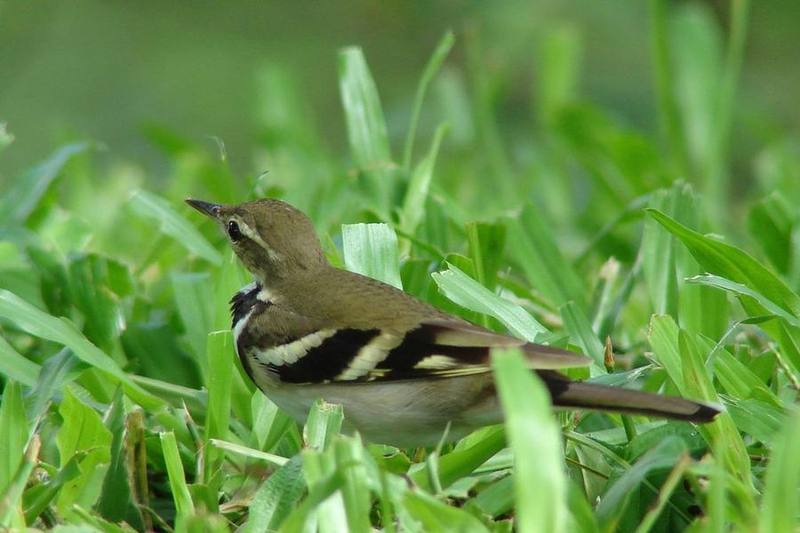
Photo: Nur Hussein · CC BY-SA 4.0 (May be cropped or resized)
Dendronanthus indicus
Rare visitor: recorded only occasionally in this country
Basic stats
Habitat
Forest clearings and shaded forest, including coffee plantations
Range
Breeds in temperate east Asia; winters across tropical Asia from India to Indonesia
Size
About 18cm
The forest wagtail is a slender, long-tailed wagtail about 18cm long and the only member of its genus. It is olive-brown on the back and crown, with black wings carrying two yellow wing bars and white tertial edges, a white eyebrow above a dark eye stripe, and white underparts crossed by a double black breast band, the upper band bib-like and the lower often broken. The sexes look alike. Unlike other wagtails it wags its tail from side to side rather than up and down, and it is the only wagtail that nests in trees (Wikipedia, general species account).
As its name suggests, it is a forest bird, using clearings in woodland when breeding and well-shaded forest, forest paths and coffee plantations in winter. It breeds in temperate east Asia and winters across tropical Asia from India to Indonesia. Its call is a single pink, often given on the ground or high in flight, and it has a soft, lilting song. In India it is a winter migrant with a moderate range. SoIB 2023 estimates a long-term decline of about 74% and a current fall of about 7% a year, and rates it a High conservation priority (Wikipedia, general species account; SoIB 2023).
Quick answers
- What habitat does the Forest Wagtail live in?
- Forest clearings and shaded forest, including coffee plantations
- Where is the Forest Wagtail found?
- Breeds in temperate east Asia; winters across tropical Asia from India to Indonesia
- How big is the Forest Wagtail?
- About 18cm
In Vietnam
GBIF holds 245 records of the Forest Wagtail from 7 protected areas in Vietnam, dated 1987 to 2024. Most come from Cat Tien National Park and Cuc Phuong National Park.
Where it has been recorded
- Cat Tien National Park 202 records, latest 2024
- Cuc Phuong National Park 23 records, latest 2024
- Bach Ma National Park 5 records, latest 2023
- Con Dao National Park 4 records, latest 2019
- Ba Vi National Park 4 records, latest 2024
- Cat Ba National Park 4 records, latest 2024
- Da Lat Plateau & Bidoup-Nui Ba 3 records, latest 2023
Covered in our place guides: Cat Tien National Park, Cuc Phuong National Park, Bach Ma National Park, Con Dao National Park, Da Lat Plateau & Bidoup-Nui Ba.
Also in our other guides: India, Nepal.
Records: GBIF occurrence data matched to park boundaries (© OpenStreetMap contributors, ODbL; Wikidata). Counts show recording effort, not how common the species is.