
 Wildlife
of Vietnam
Dark-sided Flycatcher
Thrushes, Chats & Flycatchers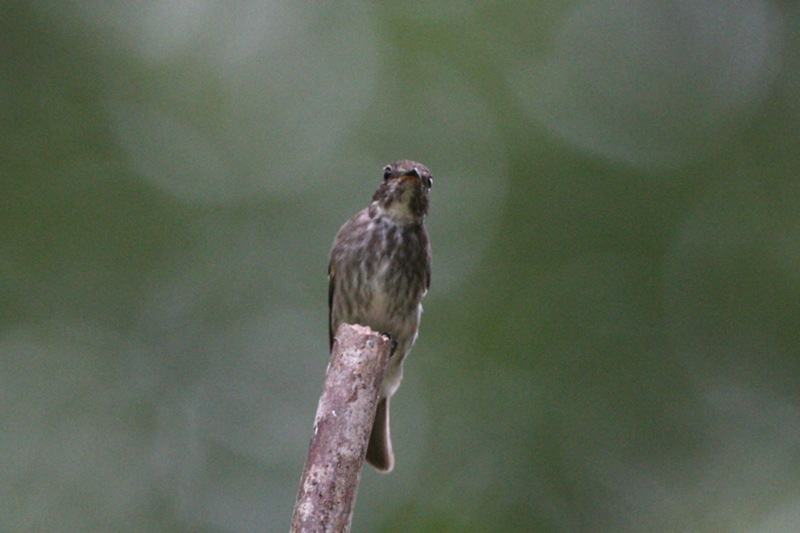
Photo: Lip Kee · CC BY-SA 2.0 (May be cropped or resized)
Muscicapa sibirica
Rare visitor: recorded only occasionally in this country
Basic stats
Habitat
Cup-shaped nest built by the female up to 8m up on a tree branch or sometimes in a hole
Range
Wide breeding distribution in the East Palearctic; northern birds migrate south for the winter
Clutch size
3–4 eggs
Size
13–14cm
The dark-sided flycatcher is a small flycatcher, 13 to 14cm long, with a wide breeding distribution in the East Palearctic, northern birds migrating south for the winter. The upperparts are plain, dark grey-brown apart from a pale wingbar and pale tertial edging, and the breast and flanks are streaked dark grey-brown. A pale submoustachial stripe and dark malar stripe outline a white throat and half-collar, and the bill is short and dark (Wikipedia, general species account).
Like other flycatchers, it feeds by perching on an exposed branch and waiting. The female builds a cup-shaped nest up to 8m above the ground on a branch or sometimes in a hole, and incubates three or four eggs while the male feeds her. The subspecies rothschildi breeds in western China and Myanmar. The song is thin, high-pitched notes with trills and whistles; the call is a metallic tinkling.
Quick answers
- What habitat does the Dark-sided Flycatcher live in?
- Cup-shaped nest built by the female up to 8m up on a tree branch or sometimes in a hole
- Where is the Dark-sided Flycatcher found?
- Wide breeding distribution in the East Palearctic; northern birds migrate south for the winter
- How many eggs does the Dark-sided Flycatcher lay?
- 3–4 eggs
- How big is the Dark-sided Flycatcher?
- 13–14cm
In Vietnam
GBIF holds 173 records of the Dark-sided Flycatcher from 12 protected areas in Vietnam, dated 1988 to 2024. Most come from Cat Tien National Park and Cuc Phuong National Park.
Where it has been recorded
- Cat Tien National Park 61 records, latest 2024
- Cuc Phuong National Park 22 records, latest 2024
- Tam Dao National Park 20 records, latest 2018
- Bach Ma National Park 12 records, latest 2024
- Da Lat Plateau & Bidoup-Nui Ba 11 records, latest 2024
- Ba Vi National Park 10 records, latest 2023
- Son Tra special-use forest 10 records, latest 2024
- Yok Don National Park 8 records, latest 2022
Plus 4 more sites.
Covered in our place guides: Cat Tien National Park, Cuc Phuong National Park, Bach Ma National Park, Da Lat Plateau & Bidoup-Nui Ba, Yok Don National Park, Phong Nha-Ke Bang National Park.
Also in our other guides: Bhutan.
Records: GBIF occurrence data matched to park boundaries (© OpenStreetMap contributors, ODbL; Wikidata). Counts show recording effort, not how common the species is.