
 Wildlife
of Vietnam
Crested Serpent Eagle
Birds of Prey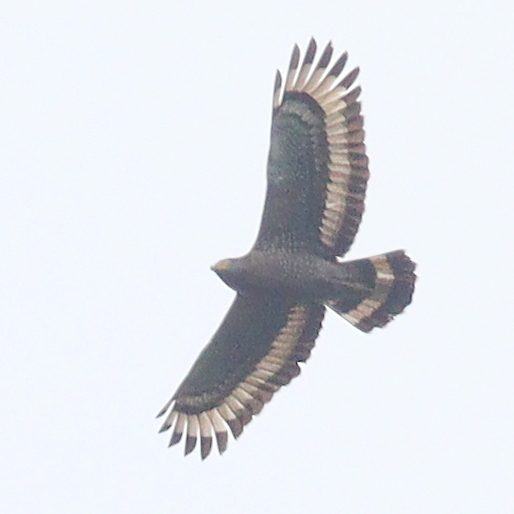
Photo: Jan Ebr & Ivana Ebrová · CC BY 4.0 (May be cropped or resized)
Spilornis cheela
Rare visitor: recorded only occasionally in this country
Basic stats
Diet
Mainly snakes and lizards; also birds, mammals, amphibians, fish and insects
Habitat
Forest, often near wet grassland
Range
Tropical Asia: Indian subcontinent, Southeast Asia and East Asia
The crested serpent eagle is a stocky, medium-large dark brown eagle with rounded wings and a short tail. A short black-and-white fan-shaped crest gives it a thick-necked, maned look, and the bare face and feet are yellow; the underparts are spotted white and yellowish-brown. In soaring flight the broad, paddle-shaped wings are held in a shallow V and the tail and flight feathers show broad white bars against black. Young birds show much white on the head (Wikipedia, general species account).
It is a reptile-eater that hunts over forest, often near wet grassland, mainly for snakes and lizards, though it also takes birds, mammals, amphibians, fish and large insects. It often soars over the canopy calling a loud, piercing two- or three-note cry. Its range across tropical Asia includes many forms, and some authorities treat several of them as separate species; island forms such as the Andaman and South Nicobar serpent eagles are now split. In India it is resident across a very large range; SoIB 2023 finds its trends uncertain and rates it a Low conservation priority (Wikipedia, general species account; SoIB 2023).
Quick answers
- What does the Crested Serpent Eagle eat?
- Mainly snakes and lizards; also birds, mammals, amphibians, fish and insects
- What habitat does the Crested Serpent Eagle live in?
- Forest, often near wet grassland
- Where is the Crested Serpent Eagle found?
- Tropical Asia: Indian subcontinent, Southeast Asia and East Asia
In Vietnam
GBIF holds 1,616 records of the Crested Serpent Eagle from 25 protected areas in Vietnam, dated 1984 to 2026. Most come from Cat Tien National Park and Cuc Phuong National Park.
Where it has been recorded
- Cat Tien National Park 824 records, latest 2026
- Cuc Phuong National Park 177 records, latest 2024
- Da Lat Plateau & Bidoup-Nui Ba 150 records, latest 2024
- Phong Nha-Ke Bang National Park 123 records, latest 2024
- Bach Ma National Park 56 records, latest 2024
- Ngoc Linh Nature Reserve 52 records, latest 2024
- Van Long Nature Reserve 37 records, latest 2026
- Tam Dao National Park 32 records, latest 2024
Plus 17 more sites.
Covered in our place guides: Cat Tien National Park, Cuc Phuong National Park, Da Lat Plateau & Bidoup-Nui Ba, Phong Nha-Ke Bang National Park, Bach Ma National Park, Van Long Nature Reserve.
Seen on trips we host
- Vietnam Bird Tour Asia, 2023
- Vietnam 2026 Bird Tour Asia, 2026
Also in our other guides: India, Nepal.
Records: GBIF occurrence data matched to park boundaries (© OpenStreetMap contributors, ODbL; Wikidata). Counts show recording effort, not how common the species is.