
 Wildlife
of Vietnam
Chestnut Bunting
Finches, Sparrows & Buntings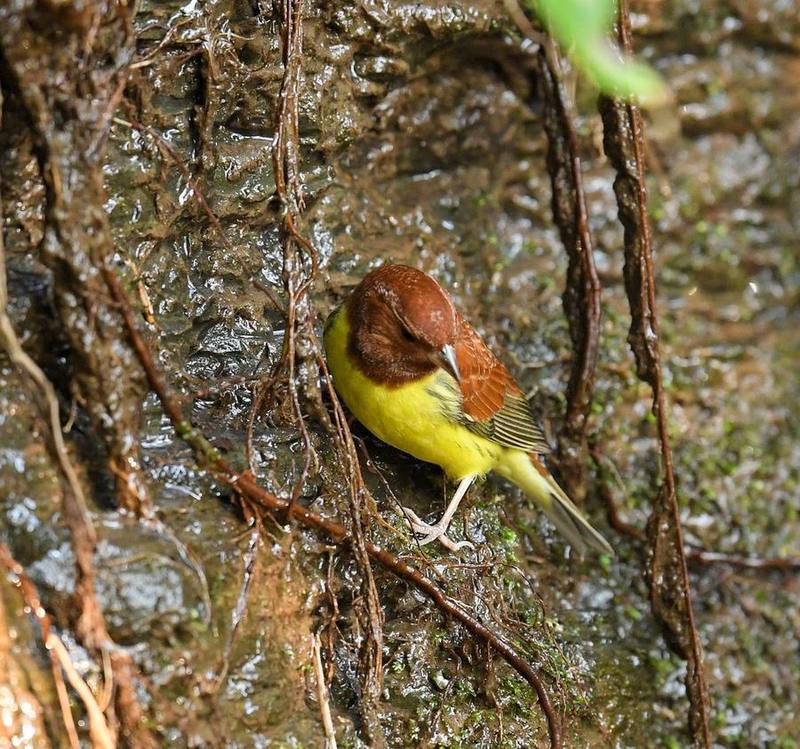
Photo: (c) Rejoice Gassah, some rights reserved (CC BY) · CC-BY (May be cropped or resized)
Schoeniclus rutilus
Also known as: Emberiza rutila
Rare visitor: recorded only occasionally in this country
Basic stats
Diet
Invertebrates (SoIB guild)
Habitat
Open forest with plenty of ground cover and shrubs in the breeding season
Range
Breeds in Siberia, northern Mongolia and north-eastern China; a long-distance migrant, wintering in southern China, south-east Asia and north-east India
Size
14–15cm
The chestnut bunting is a fairly small bunting, 14–15 cm long, of the East Palearctic. The tail is fairly short with little or no white on the outer feathers. Breeding males have bright chestnut-brown upperparts and head with a yellow breast and belly streaked on the sides, while the female is mostly dull brown with dark streaks above and mainly pale yellow underparts; non-breeding males are similar but duller, with the chestnut partly hidden by pale feather fringes (Wikipedia, general species account).
It breeds in Siberia, northern Mongolia and north-eastern China, inhabiting open forest with plenty of ground cover and shrubs, and is a long-distance migrant, wintering in southern China, south-east Asia and north-east India. The variable, high-pitched song is given from a perch low in a tree, and the call is a short zick, like the little bunting's. SoIB 2023 lists it as a winter migrant of open habitat that eats invertebrates, without a priority category (Wikipedia, general species account; SoIB 2023).
Quick answers
- What does the Chestnut Bunting eat?
- Invertebrates (SoIB guild)
- What habitat does the Chestnut Bunting live in?
- Open forest with plenty of ground cover and shrubs in the breeding season
- Where is the Chestnut Bunting found?
- Breeds in Siberia, northern Mongolia and north-eastern China; a long-distance migrant, wintering in southern China, south-east Asia and north-east India
- How big is the Chestnut Bunting?
- 14–15cm
In Vietnam
GBIF holds 43 records of the Chestnut Bunting from 5 protected areas in Vietnam, dated 1988 to 2024. Most come from Tam Dao National Park and Hoang Lien National Park (Sa Pa).
Where it has been recorded
- Tam Dao National Park 15 records, latest 2022
- Hoang Lien National Park (Sa Pa) 11 records, latest 2024
- Cuc Phuong National Park 9 records, latest 2014
- Da Lat Plateau & Bidoup-Nui Ba 5 records, latest 1992
- Son Tra special-use forest 3 records, latest 2023
Covered in our place guides: Hoang Lien National Park (Sa Pa), Cuc Phuong National Park, Da Lat Plateau & Bidoup-Nui Ba.
Seen on trips we host
- Vietnam scheduled Bird Tour Asia, 2014
Also in our other guides: China, India, Nepal.
Records: GBIF occurrence data matched to park boundaries (© OpenStreetMap contributors, ODbL; Wikidata). Counts show recording effort, not how common the species is.