
 Wildlife
of Vietnam
Black Bulbul
Bulbuls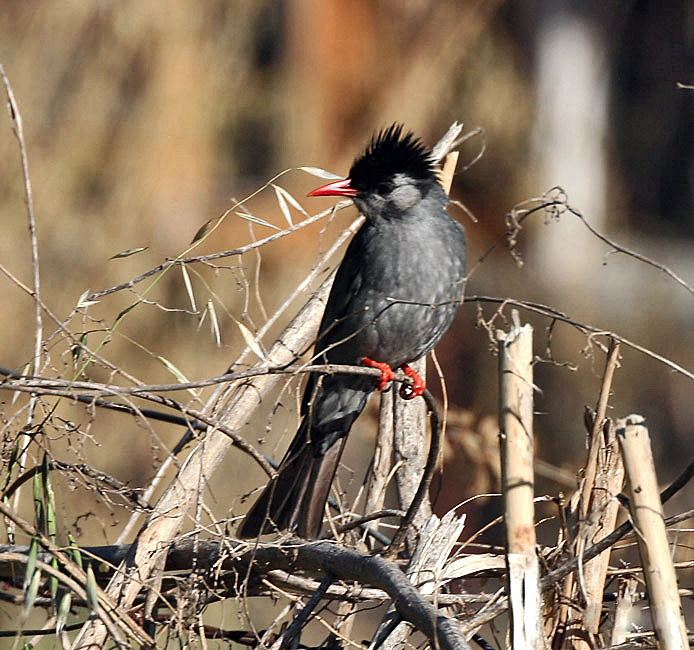
Photo: J.M.Garg · CC BY-SA 3.0 (May be cropped or resized)
Hypsipetes leucocephalus
Rare visitor: recorded only occasionally in this country
Basic stats
Habitat
Nest a cup in a tree or bush fork, of grasses, dry leaves, mosses, lichens and cobwebs
Range
Primarily the Himalayas, from Pakistan eastward to Southeast Asia
Clutch size
Usually 2–3 eggs
Size
24–25cm
The black bulbul, also called the Himalayan or Asian black bulbul, is a bulbul 24 to 25cm long with a long tail, found primarily in the Himalayas with a range stretching from Pakistan eastward to Southeast Asia. The legs and bill are always rich orange-red, and the body plumage ranges from slate grey to shimmering black depending on the race, with some white-headed morphs (Wikipedia, general species account).
Sexes are similar, while young birds lack the crest and have whitish underparts with a grey breast band. They are quite noisy, making loud cheeping, mewing and grating calls, and the Himalayan form has been reported to make a call resembling a goat kid. The nest is a cup in a fork of a tree or bush, made of grasses, dry leaves, mosses, lichens and cobwebs, with two or three eggs.
Quick answers
- What habitat does the Black Bulbul live in?
- Nest a cup in a tree or bush fork, of grasses, dry leaves, mosses, lichens and cobwebs
- Where is the Black Bulbul found?
- Primarily the Himalayas, from Pakistan eastward to Southeast Asia
- How many eggs does the Black Bulbul lay?
- Usually 2–3 eggs
- How big is the Black Bulbul?
- 24–25cm
In Vietnam
GBIF holds 1,318 records of the Black Bulbul from 20 protected areas in Vietnam, dated 1988 to 2026. Most come from Da Lat Plateau & Bidoup-Nui Ba and Cuc Phuong National Park.
Where it has been recorded
- Da Lat Plateau & Bidoup-Nui Ba 514 records, latest 2026
- Cuc Phuong National Park 172 records, latest 2024
- Tam Dao National Park 155 records, latest 2024
- Ngoc Linh Nature Reserve 114 records, latest 2024
- Cat Tien National Park 86 records, latest 2024
- Bac Huong Hoa Nature Reserve 67 records, latest 2024
- Phong Nha-Ke Bang National Park 57 records, latest 2024
- Ba Vi National Park 50 records, latest 2024
Plus 12 more sites.
Covered in our place guides: Da Lat Plateau & Bidoup-Nui Ba, Cuc Phuong National Park, Cat Tien National Park, Phong Nha-Ke Bang National Park, Hoang Lien National Park (Sa Pa), Bach Ma National Park.
Seen on trips we host
- Vietnam scheduled Bird Tour Asia, 2020
Also in our other guides: Bhutan.
Records: GBIF occurrence data matched to park boundaries (© OpenStreetMap contributors, ODbL; Wikidata). Counts show recording effort, not how common the species is.