
 Wildlife
of Vietnam
Asian Woolly-necked Stork
Storks, Herons, Ibises & Pelicans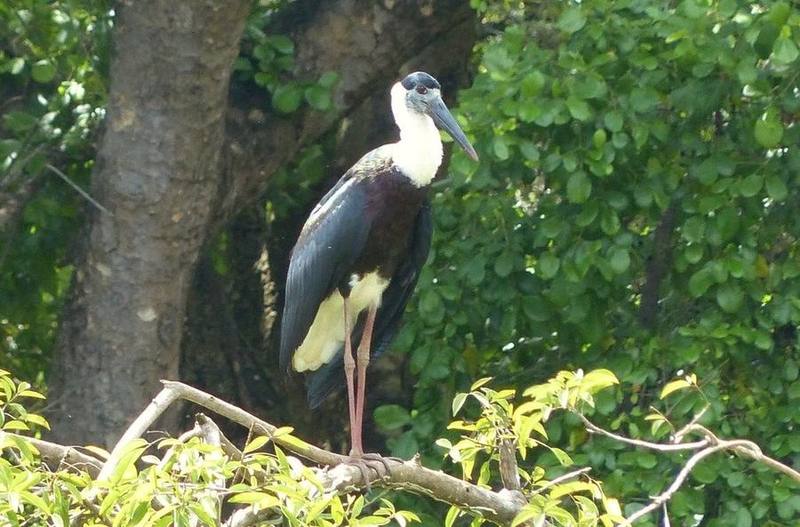
Photo: Pieter Prins · CC BY-SA 4.0 (May be cropped or resized)
Ciconia episcopus
Rare visitor: recorded only occasionally in this country
Basic stats
Habitat
Farmland, freshwater wetlands, reservoirs, canals and forest marshes
Range
Asia, from India to Indochina, the Philippines and Indonesia
Size
75–92cm tall
The Asian woolly-necked stork, or Asian woollyneck, is a medium-sized stork standing 75–92cm tall. It is glossy black overall with a black skullcap and a downy white neck that gives it its name. The lower belly and undertail coverts are white, and the elongated fore-neck feathers, iridescent with a coppery-purple tinge, can be raised in display. It has long red legs, a heavy blackish bill and a deep crimson eye. The sexes are alike, and juveniles are duller. Asian birds have a sharper edge to the black cap than African ones, which some authorities treat as a separate species (Wikipedia, general species account).
It breeds singly or in small loose colonies, nesting in trees in farmland or wetlands, on cliffs and on phone masts. It uses a wide range of freshwater habitats, from reservoirs and marshes to crop fields, canals and rivers, and forest pools, and is mostly seen in farmland and wetlands outside protected areas. It is attracted to grass and crop fires, catching insects fleeing the flames. Its species name means bishop. In India it is resident across a very large range; SoIB 2023 estimates a long-term decline of about 39% and rates it a Moderate conservation priority (Wikipedia, general species account; SoIB 2023).
Quick answers
- What habitat does the Asian Woolly-necked Stork live in?
- Farmland, freshwater wetlands, reservoirs, canals and forest marshes
- Where is the Asian Woolly-necked Stork found?
- Asia, from India to Indochina, the Philippines and Indonesia
- How big is the Asian Woolly-necked Stork?
- 75–92cm tall
In Vietnam
GBIF holds 634 records of the Asian Woolly-necked Stork from 3 protected areas in Vietnam, dated 1987 to 2024. Most come from Cat Tien National Park and Yok Don National Park.
Where it has been recorded
- Cat Tien National Park 609 records, latest 2024
- Yok Don National Park 19 records, latest 2023
- Dong Nai Culture and Nature Reserve 6 records, latest 2021
Covered in our place guides: Cat Tien National Park, Yok Don National Park.
Also in our other guides: India, Nepal.
Records: GBIF occurrence data matched to park boundaries (© OpenStreetMap contributors, ODbL; Wikidata). Counts show recording effort, not how common the species is.