
 Wildlife
of Vietnam
Asian House Martin
Swallows & Martins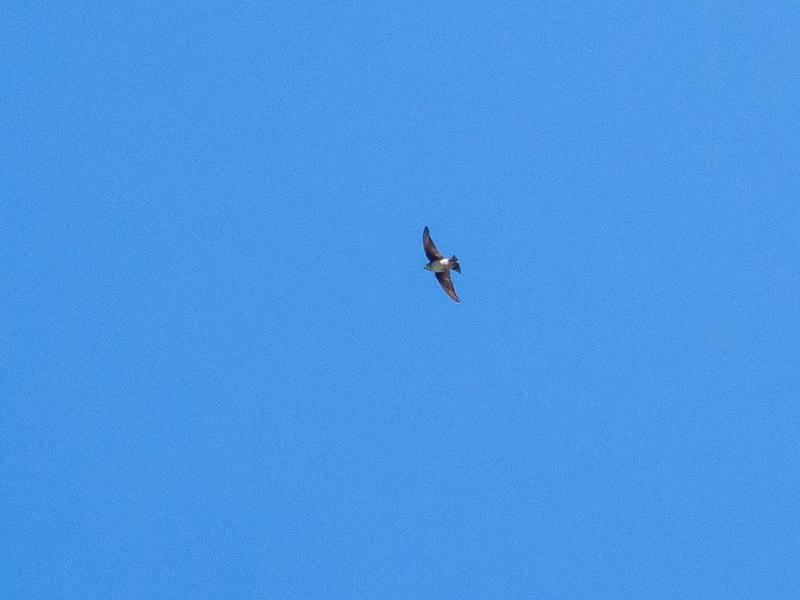
Photo: Mike Prince · CC BY 2.0 (May be cropped or resized)
Delichon dasypus
Rare visitor: recorded only occasionally in this country
Basic stats
Diet
Small insects taken in flight, usually high in the air; sometimes food picked from the ground
Habitat
Colonial mud nests under an overhang on a vertical cliff or building wall; found at 1,500–5,000m, mainly 2,400–4,000m
Range
Breeds in the Himalayas and in central and eastern Asia; winters lower in the mountains or in Southeast Asia
Clutch size
3–4 white eggs
Size
12cm
The Asian house martin is a migratory member of the swallow family, 12cm long in the nominate form, dark steel blue above with a contrasting white rump, grey-washed white underparts and a slightly forked tail. The legs and feet are brownish pink and covered with white feathers, and the bill is black. The male is somewhat whiter below than the female (Wikipedia, general species account).
Its three subspecies breed in the Himalayas and in central and eastern Asia and winter lower in the mountains or in Southeast Asia, at altitudes of 1,500 to 5,000m but mainly 2,400 to 4,000m. It breeds in colonies, building a deep mud cone lined with grasses or feathers, with three or four white eggs; both sexes build, incubate and feed. The song is a rippling metallic trill or sibilant twitter.
Quick answers
- What does the Asian House Martin eat?
- Small insects taken in flight, usually high in the air; sometimes food picked from the ground
- What habitat does the Asian House Martin live in?
- Colonial mud nests under an overhang on a vertical cliff or building wall; found at 1,500–5,000m, mainly 2,400–4,000m
- Where is the Asian House Martin found?
- Breeds in the Himalayas and in central and eastern Asia; winters lower in the mountains or in Southeast Asia
- How many eggs does the Asian House Martin lay?
- 3–4 white eggs
- How big is the Asian House Martin?
- 12cm
In Vietnam
GBIF holds 244 records of the Asian House Martin from 10 protected areas in Vietnam, dated 1990 to 2024. Most come from Da Lat Plateau & Bidoup-Nui Ba and Bach Ma National Park.
Where it has been recorded
- Da Lat Plateau & Bidoup-Nui Ba 96 records, latest 2024
- Bach Ma National Park 35 records, latest 2024
- Cat Tien National Park 33 records, latest 2024
- Ngoc Linh Nature Reserve 29 records, latest 2024
- Tam Dao National Park 24 records, latest 2019
- Hoang Lien National Park (Sa Pa) 7 records, latest 2023
- Yok Don National Park 6 records, latest 2017
- Bac Huong Hoa Nature Reserve 6 records, latest 2024
Plus 2 more sites.
Covered in our place guides: Da Lat Plateau & Bidoup-Nui Ba, Bach Ma National Park, Cat Tien National Park, Hoang Lien National Park (Sa Pa), Yok Don National Park, Cuc Phuong National Park.
Seen on trips we host
- Vietnam scheduled Bird Tour Asia, 2015
- Vietnam 2026 Bird Tour Asia, 2026
Also in our other guides: Bhutan.
Records: GBIF occurrence data matched to park boundaries (© OpenStreetMap contributors, ODbL; Wikidata). Counts show recording effort, not how common the species is.