
 Wildlife
of Vietnam
Ashy Minivet
Crows, Drongos, Orioles & Shrikes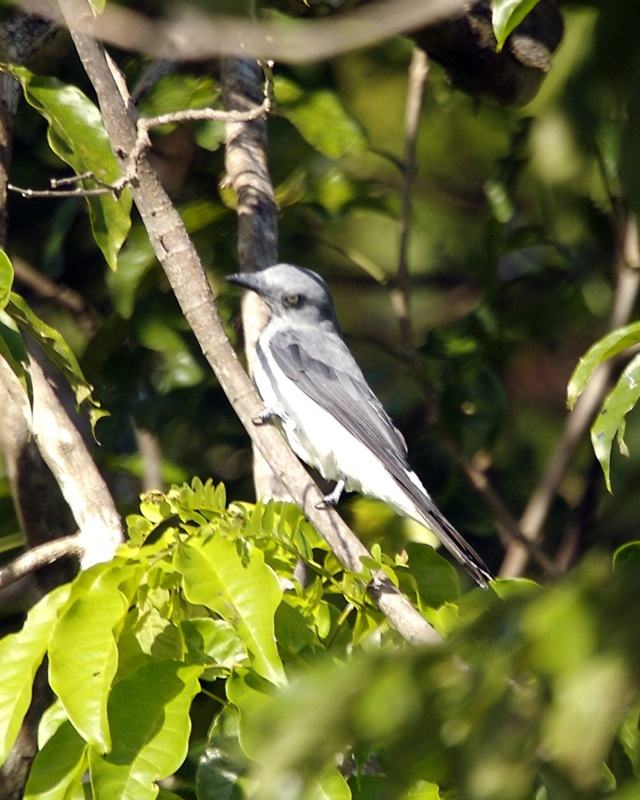
Photo: Lip Kee Yap · CC BY-SA 2.0 (May be cropped or resized)
Pericrocotus divaricatus
Rare visitor: recorded only occasionally in this country
Basic stats
Diet
Insects, foraged in the canopy
Habitat
Forest and plantation
Range
Breeds in south-east Siberia, north-east China, Korea and Japan
Clutch size
4–7 eggs
Incubation period
17–18 days
Size
18.5–20cm
The ashy minivet is a minivet of eastern Asia, 18.5–20 cm long, and unlike most minivets, which show yellow, orange and red, it has only greys, whites and blacks. The male has a white face and black nape, is grey above and whitish below, with white outer tail feathers, while females can be confused with the female of the brown-rumped minivet. It breeds in south-east Siberia, north-east China, Korea and Japan (Wikipedia, general species account).
Four to seven eggs are laid and incubated for 17 to 18 days. It forages in the canopy, often with other minivets and in mixed-species flocks, and has a high-pitched metallic trill. It was first noted on the Indian mainland only in 1965, though it had been reported from the Andaman Islands in 1897. SoIB 2023 lists it as a winter migrant of forest and plantation that eats invertebrates, without a priority category (Wikipedia, general species account; SoIB 2023).
Quick answers
- What does the Ashy Minivet eat?
- Insects, foraged in the canopy
- What habitat does the Ashy Minivet live in?
- Forest and plantation
- Where is the Ashy Minivet found?
- Breeds in south-east Siberia, north-east China, Korea and Japan
- How many eggs does the Ashy Minivet lay?
- 4–7 eggs
- How long are the eggs of the Ashy Minivet incubated?
- 17–18 days
- How big is the Ashy Minivet?
- 18.5–20cm
In Vietnam
GBIF holds 640 records of the Ashy Minivet from 13 protected areas in Vietnam, dated 1989 to 2024. Most come from Cat Tien National Park and Cuc Phuong National Park.
Where it has been recorded
- Cat Tien National Park 524 records, latest 2024
- Cuc Phuong National Park 29 records, latest 2024
- Phong Nha-Ke Bang National Park 27 records, latest 2023
- Bach Ma National Park 13 records, latest 2019
- Son Tra special-use forest 8 records, latest 2024
- Dong Nai Culture and Nature Reserve 7 records, latest 2021
- Yok Don National Park 6 records, latest 2023
- Phu Quoc National Park 5 records, latest 2021
Plus 5 more sites.
Covered in our place guides: Cat Tien National Park, Cuc Phuong National Park, Phong Nha-Ke Bang National Park, Bach Ma National Park, Yok Don National Park, Da Lat Plateau & Bidoup-Nui Ba.
Seen on trips we host
- Vietnam scheduled Bird Tour Asia, 2014
Also in our other guides: India, Malaysia, Nepal, Singapore, Sumatra, Thailand.
Records: GBIF occurrence data matched to park boundaries (© OpenStreetMap contributors, ODbL; Wikidata). Counts show recording effort, not how common the species is.