
 Wildlife
of Vietnam
Yellow-legged Buttonquail
Shorebirds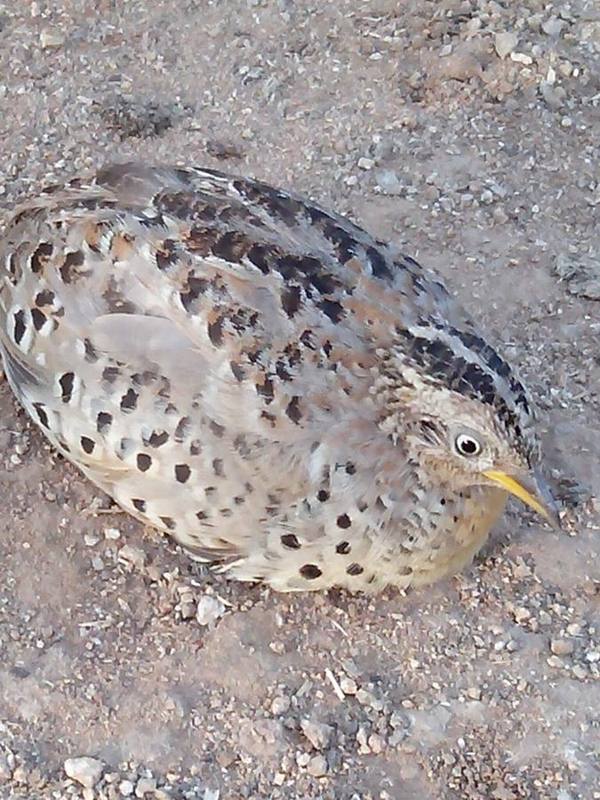
Photo: (c) parithi, some rights reserved (CC BY) · CC-BY (May be cropped or resized)
Turnix tanki
Rare visitor: recorded only occasionally in this country
Basic stats
Diet
Plants and seeds
Habitat
Non-specialised habitat
Range
Indian subcontinent, East Asia and Southeast Asia
Size
15–18cm
The yellow-legged buttonquail is a small buttonquail, 15–18 cm long. The buttonquails resemble true quails but are unrelated, and are peculiar in that the females are larger and more colourful than the males and are polyandrous. The tail is short and the wings have rounded ends. The adult male has a black crown with a buff margin, sometimes with a buff central streak, and the front and sides of the head are buff, each feather with a black tip (Wikipedia, general species account).
Females offer food to males during courtship and leave incubation to the male once the eggs are laid. In non-breeding plumage the female's rufous collar becomes mixed with grey and the plumage greyer. In most of its range it is resident, but it migrates by night to the drier parts of India in the wet season, and also to Korea and south-eastern Russia, where it breeds. One subspecies is found in Pakistan, India, Nepal and the Andaman and Nicobar Islands. SoIB 2023 rates it a Moderate conservation priority, with a Restricted range of about 15,500 km² and insufficient data on trends (Wikipedia, general species account; SoIB 2023).
Quick answers
- What does the Yellow-legged Buttonquail eat?
- Plants and seeds
- What habitat does the Yellow-legged Buttonquail live in?
- Non-specialised habitat
- Where is the Yellow-legged Buttonquail found?
- Indian subcontinent, East Asia and Southeast Asia
- How big is the Yellow-legged Buttonquail?
- 15–18cm
In Vietnam
GBIF holds 19 records of the Yellow-legged Buttonquail from 2 protected areas in Vietnam, dated 1988 to 2024. Most come from Cat Tien National Park and Tam Dao National Park.
Where it has been recorded
- Cat Tien National Park 15 records, latest 2024
- Tam Dao National Park 4 records, latest 2007
Covered in our place guides: Cat Tien National Park.
Also in our other guides: India, Korea, Nepal.
Records: GBIF occurrence data matched to park boundaries (© OpenStreetMap contributors, ODbL; Wikidata). Counts show recording effort, not how common the species is.