
 Wildlife
of Vietnam
White-rumped Munia
Finches, Sparrows & Buntings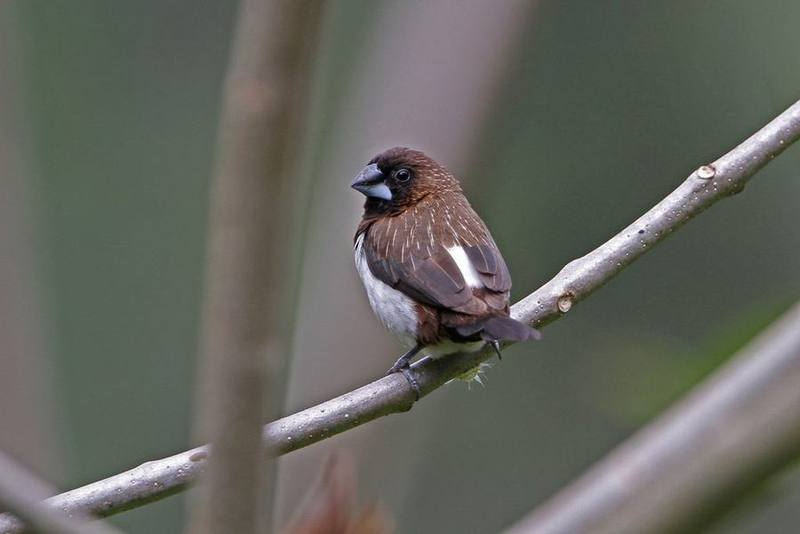
Photo: Christoph Moning · CC BY 4.0 (May be cropped or resized)
Lonchura striata
Rare visitor: recorded only occasionally in this country
Basic stats
Diet
Often seen near water feeding on algae
Habitat
Large domed grass nest in a tree, bush or grass; uses abandoned Baya weaver nests
Clutch size
3–8 white eggs
Size
10–11cm
The white-rumped munia, or white-rumped mannikin, is a small member of the waxbill family, about 10 to 11cm long, with a stubby grey bill and a long black pointed tail. The adults are brown above and on the breast and lighter below, with a white rump; the sexes are almost impossible to distinguish, though males have a bulkier head and bill (Wikipedia, general species account).
The nest is a large domed grass structure in a tree, bush or grass, into which three to eight white eggs are laid, and the species uses abandoned nests of the Baya weaver. It has often been observed near water feeding on algae. A domesticated hybrid, the society finch, is said by some sources to have this species in its ancestry. The source read does not name Bhutan.
Quick answers
- What does the White-rumped Munia eat?
- Often seen near water feeding on algae
- What habitat does the White-rumped Munia live in?
- Large domed grass nest in a tree, bush or grass; uses abandoned Baya weaver nests
- How many eggs does the White-rumped Munia lay?
- 3–8 white eggs
- How big is the White-rumped Munia?
- 10–11cm
In Vietnam
GBIF holds 637 records of the White-rumped Munia from 18 protected areas in Vietnam, dated 1988 to 2026. Most come from Cat Tien National Park and Tam Dao National Park.
Where it has been recorded
- Cat Tien National Park 455 records, latest 2026
- Tam Dao National Park 28 records, latest 2023
- Da Lat Plateau & Bidoup-Nui Ba 25 records, latest 2024
- Phong Nha-Ke Bang National Park 20 records, latest 2024
- Hoang Lien National Park (Sa Pa) 19 records, latest 2024
- Cuc Phuong National Park 17 records, latest 2023
- Ngoc Linh Nature Reserve 12 records, latest 2023
- Van Long Nature Reserve 10 records, latest 2026
Plus 10 more sites.
Covered in our place guides: Cat Tien National Park, Da Lat Plateau & Bidoup-Nui Ba, Phong Nha-Ke Bang National Park, Hoang Lien National Park (Sa Pa), Cuc Phuong National Park, Van Long Nature Reserve.
Also in our other guides: Bhutan.
Records: GBIF occurrence data matched to park boundaries (© OpenStreetMap contributors, ODbL; Wikidata). Counts show recording effort, not how common the species is.