
 Wildlife
of Vietnam
Siberian Rubythroat
Thrushes, Chats & Flycatchers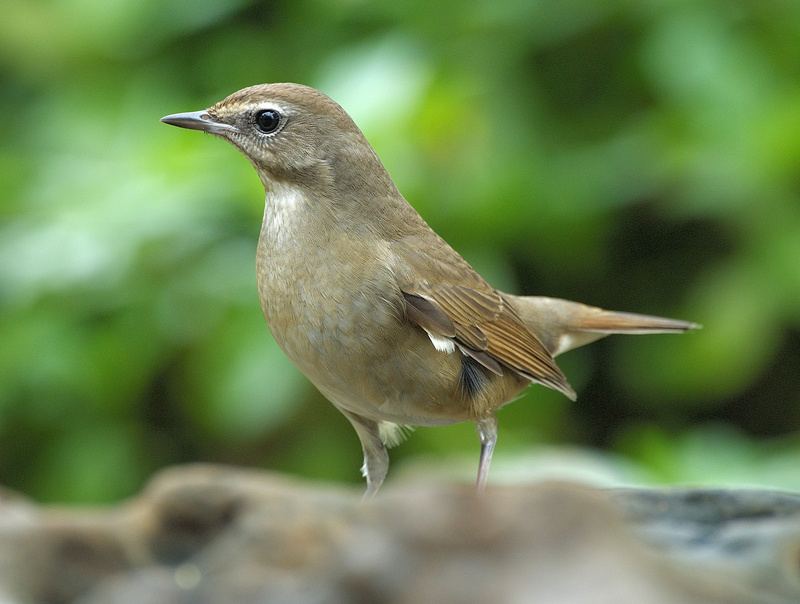
Photo: Robert tdc · CC BY-SA 2.0 (May be cropped or resized)
Calliope calliope
Also known as: Luscinia calliope
Rare visitor: recorded only occasionally in this country
Basic stats
Diet
Insects
Habitat
Breeds in mixed coniferous forest with undergrowth in Siberia; nests near the ground
Range
Breeds in Siberia; winters in Thailand, India, Indonesia and Bangladesh
The Siberian rubythroat was formerly classed as a member of the thrush family and is now generally considered an Old World flycatcher. It is plain brown above except for the distinctive black tail with red side patches, with a strong white eyebrow; the male has a red throat edged with a narrow black and then a broad white border, and females lack the brightly coloured throat and borders. It winters in Thailand, India, Indonesia and Bangladesh (Wikipedia, general species account).
It is a migratory insectivorous species breeding in mixed coniferous forests with undergrowth in Siberia, nesting near the ground. The male's song is like a harder version of the garden warbler's, and the species and similar small European birds are often called chats. SoIB 2023 rates it a Low conservation priority, a winter migrant of wetland that eats invertebrates, with a Moderate range of about 117,000 km² and insufficient data on trends (Wikipedia, general species account; SoIB 2023).
Quick answers
- What does the Siberian Rubythroat eat?
- Insects
- What habitat does the Siberian Rubythroat live in?
- Breeds in mixed coniferous forest with undergrowth in Siberia; nests near the ground
- Where is the Siberian Rubythroat found?
- Breeds in Siberia; winters in Thailand, India, Indonesia and Bangladesh
In Vietnam
GBIF holds 223 records of the Siberian Rubythroat from 16 protected areas in Vietnam, dated 1989 to 2024. Most come from Cat Tien National Park and Da Lat Plateau & Bidoup-Nui Ba.
Where it has been recorded
- Cat Tien National Park 43 records, latest 2024
- Da Lat Plateau & Bidoup-Nui Ba 43 records, latest 2024
- Cuc Phuong National Park 34 records, latest 2024
- Van Long Nature Reserve 19 records, latest 2024
- Ngoc Linh Nature Reserve 17 records, latest 2022
- Tam Dao National Park 15 records, latest 2020
- Son Tra special-use forest 9 records, latest 2024
- Ba Vi National Park 7 records, latest 2010
Plus 8 more sites.
Covered in our place guides: Cat Tien National Park, Da Lat Plateau & Bidoup-Nui Ba, Cuc Phuong National Park, Van Long Nature Reserve, Bach Ma National Park, Hoang Lien National Park (Sa Pa).
Also in our other guides: Bhutan, India, Nepal.
Records: GBIF occurrence data matched to park boundaries (© OpenStreetMap contributors, ODbL; Wikidata). Counts show recording effort, not how common the species is.