
 Wildlife
of Vietnam
Scarlet-backed Flowerpecker
Sunbirds, Flowerpeckers & Leafbirds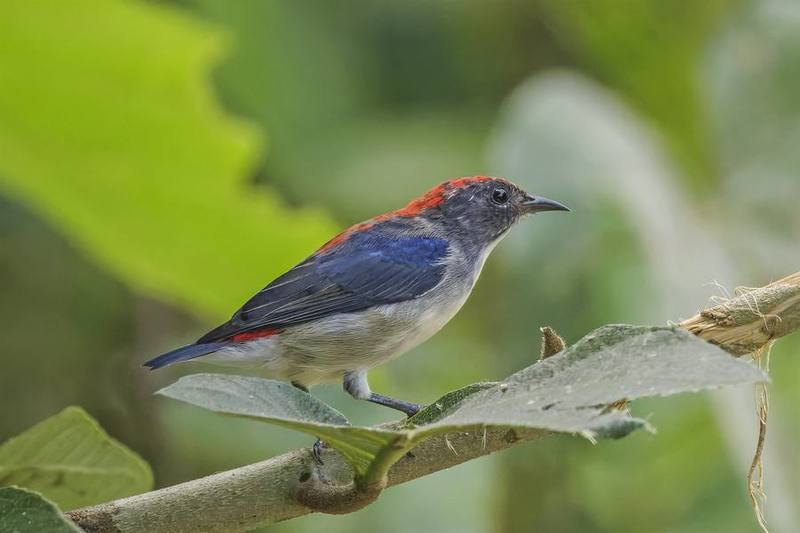
Photo: Charles J. Sharp · CC BY-SA 4.0 (May be cropped or resized)
Dicaeum cruentatum
Rare visitor: recorded only occasionally in this country
Basic stats
Diet
Fruit, including figs of Ficus fistulosa and F. grossularoides
Habitat
Subtropical or tropical moist lowland forest, wooded areas and gardens, up to 1,000m; pouch-shaped nest hanging from a branch high in a tree, with a side entrance
Range
Bangladesh, Bhutan, Brunei, Cambodia, China, India, Indonesia, Laos, Malaysia, Myanmar, Nepal, Singapore, Thailand and Vietnam
Size
9cm
Weight
7–8g
The scarlet-backed flowerpecker is a small, short-tailed bird, 9 cm long and 7–8 g, found up to 1,000 m in subtropical or tropical moist lowland forest, wooded areas and gardens. It is sexually dimorphic: the male has navy-blue upperparts, face, wings and tail with a broad bright red streak down its back from the crown to the upper tail coverts, while the female and juvenile are predominantly olive-green. It is found across Bangladesh, Bhutan, Brunei, Cambodia, China, India, Indonesia, Laos, Malaysia, Myanmar, Nepal, Singapore, Thailand and Vietnam, and has been recorded from both native and plantation forest in West Bengal (Wikipedia, general species account).
It has been observed feeding on the figs of Ficus fistulosa and F. grossularoides in Bukit Timah Nature Reserve in Singapore. It weaves a pouch-shaped nest hanging from a branch high in a tree, with a side entrance typical of the flowerpecker family. SoIB 2023 rates it a Low conservation priority, a resident of forest and plantation with a Moderate range of about 117,000 km² and a stable long-term trend (Wikipedia, general species account; SoIB 2023).
Quick answers
- What does the Scarlet-backed Flowerpecker eat?
- Fruit, including figs of Ficus fistulosa and F. grossularoides
- What habitat does the Scarlet-backed Flowerpecker live in?
- Subtropical or tropical moist lowland forest, wooded areas and gardens, up to 1,000m; pouch-shaped nest hanging from a branch high in a tree, with a side entrance
- Where is the Scarlet-backed Flowerpecker found?
- Bangladesh, Bhutan, Brunei, Cambodia, China, India, Indonesia, Laos, Malaysia, Myanmar, Nepal, Singapore, Thailand and Vietnam
- How big is the Scarlet-backed Flowerpecker?
- 9cm
- How much does the Scarlet-backed Flowerpecker weigh?
- 7–8g
In Vietnam
GBIF holds 1,250 records of the Scarlet-backed Flowerpecker from 21 protected areas in Vietnam, dated 1990 to 2026. Most come from Cat Tien National Park and Cuc Phuong National Park.
Where it has been recorded
- Cat Tien National Park 961 records, latest 2026
- Cuc Phuong National Park 68 records, latest 2026
- Cat Ba National Park 41 records, latest 2024
- Son Tra special-use forest 34 records, latest 2024
- Phu Quoc National Park 24 records, latest 2024
- Yok Don National Park 16 records, latest 2024
- Dong Nai Culture and Nature Reserve 14 records, latest 2024
- Van Long Nature Reserve 12 records, latest 2024
Plus 13 more sites.
Covered in our place guides: Cat Tien National Park, Cuc Phuong National Park, Yok Don National Park, Van Long Nature Reserve, Bach Ma National Park, Da Lat Plateau & Bidoup-Nui Ba.
Also in our other guides: India, Malaysia, Nepal, Singapore, Sumatra, Thailand.
Records: GBIF occurrence data matched to park boundaries (© OpenStreetMap contributors, ODbL; Wikidata). Counts show recording effort, not how common the species is.