
 Wildlife
of Vietnam
Plumbeous Water Redstart
Thrushes, Chats & Flycatchers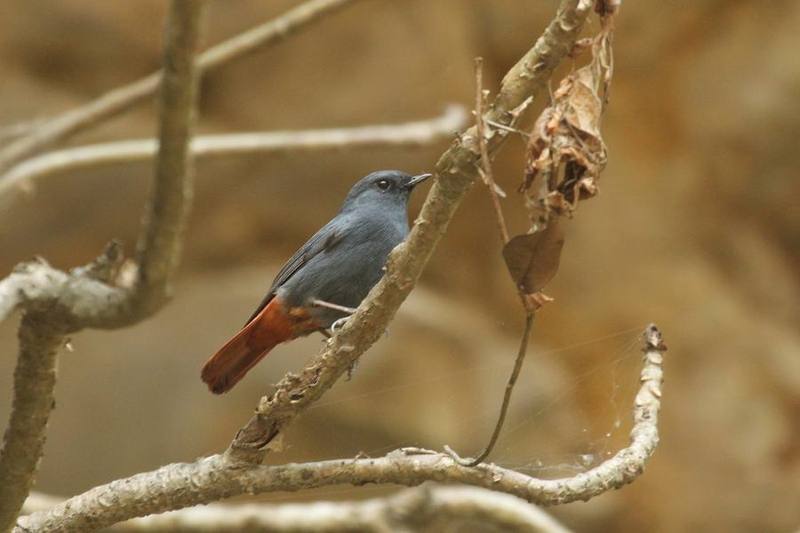
Photo: (c) Barry Stewart, some rights reserved (CC BY) · CC-BY (May be cropped or resized)
Phoenicurus fuliginosus
Rare visitor: recorded only occasionally in this country
Basic stats
Diet
Invertebrates, including flies caught over rivers
Habitat
Rivers and streams at relatively high elevations; 2,000–4,100m in the Himalaya
Range
South Asia, Southeast Asia and China: Afghanistan, Bangladesh, Bhutan, China, India, Laos, Myanmar, Nepal, Pakistan, Thailand and Vietnam
Size
14cm
Weight
Males 22g, females 18.8g
The plumbeous water redstart is a passerine of the Old World flycatcher family, typically 14 cm long, males averaging 22 g and females 18.8 g. Males are slate blue and females grey, the common name referring to a colour resembling lead. It is found in Afghanistan, Bangladesh, Bhutan, China, India, Laos, Myanmar, Nepal, Pakistan, Thailand and Vietnam, typically at relatively high elevations, in the Himalaya between 2,000 and 4,100 m (Wikipedia, general species account).
To catch flies over rivers, it flies vertically until at least 20 feet above the water, then glides down in a spiral to the same place. SoIB 2023 rates it a High conservation priority, a resident and local migrant of wetland with a Moderate range of about 186,000 km², a decline of about 40% over the long term and a current decline of about 3% a year (Wikipedia, general species account; SoIB 2023).
Quick answers
- What does the Plumbeous Water Redstart eat?
- Invertebrates, including flies caught over rivers
- What habitat does the Plumbeous Water Redstart live in?
- Rivers and streams at relatively high elevations; 2,000–4,100m in the Himalaya
- Where is the Plumbeous Water Redstart found?
- South Asia, Southeast Asia and China: Afghanistan, Bangladesh, Bhutan, China, India, Laos, Myanmar, Nepal, Pakistan, Thailand and Vietnam
- How big is the Plumbeous Water Redstart?
- 14cm
- How much does the Plumbeous Water Redstart weigh?
- Males 22g, females 18.8g
In Vietnam
GBIF holds 366 records of the Plumbeous Water Redstart from 7 protected areas in Vietnam, dated 1995 to 2024. Most come from Hoang Lien National Park (Sa Pa) and Ngoc Linh Nature Reserve.
Where it has been recorded
- Hoang Lien National Park (Sa Pa) 143 records, latest 2024
- Ngoc Linh Nature Reserve 108 records, latest 2024
- Da Lat Plateau & Bidoup-Nui Ba 92 records, latest 2024
- Song Thanh National Park 9 records, latest 2018
- Phja Oac - Phja Den National Park 8 records, latest 2023
- Phong Nha-Ke Bang National Park 3 records, latest 2018
- Ba Be National Park 3 records, latest 2023
Covered in our place guides: Hoang Lien National Park (Sa Pa), Da Lat Plateau & Bidoup-Nui Ba, Phong Nha-Ke Bang National Park.
Also in our other guides: India, Korea, Nepal.
Records: GBIF occurrence data matched to park boundaries (© OpenStreetMap contributors, ODbL; Wikidata). Counts show recording effort, not how common the species is.