
 Wildlife
of Vietnam
Pied Falconet
Birds of Prey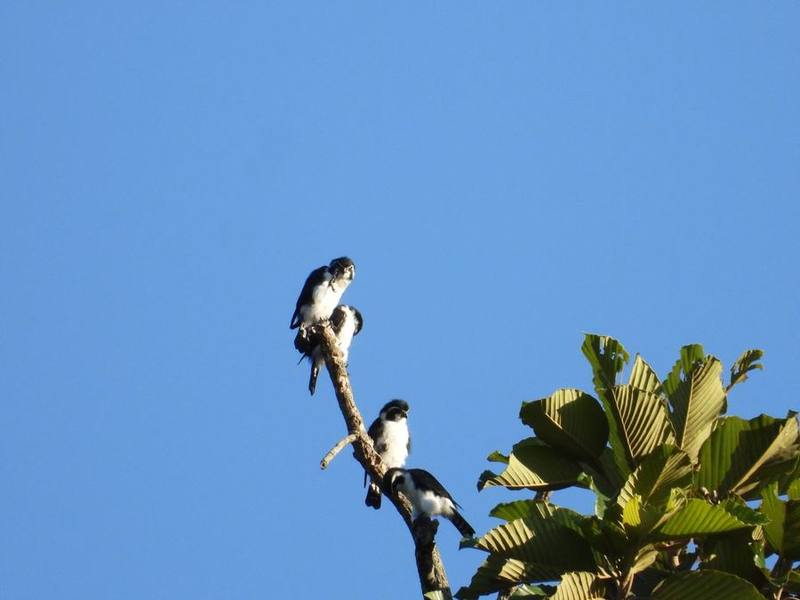
Photo: (c) Rohit Naniwadekar, some rights reserved (CC BY) · CC-BY (May be cropped or resized)
Microhierax melanoleucos
Rare visitor: recorded only occasionally in this country
Basic stats
Habitat
Temperate forest; nests in old woodpecker and barbet holes
Range
Bangladesh, Bhutan, China, India, Laos and Vietnam
Clutch size
3–4 white eggs
Size
7–7.5 inches (about 18–19cm)
Weight
55–75g
The pied falconet, also called the white-legged falconet, is a small black and white raptor in the genus that includes the smallest birds of prey in the world. It measures about 18 to 19cm and weighs 55 to 75g. The face is white with a prominent black patch around the eyes, and the upperparts, including the crown, are completely black, with white bars on the black primaries (Wikipedia, general species account).
It is found in Bangladesh, Bhutan, China, India, Laos and Vietnam, in forest, and is a resident rather than a migrant. It usually perches on tree tops, flying off now and then to catch prey. It nests in old woodpecker or barbet holes, laying three or four white eggs on a bed of leaves or grass, with a breeding season from March to May. The male gives a rapid series of calls to the female in courtship.
Quick answers
- What habitat does the Pied Falconet live in?
- Temperate forest; nests in old woodpecker and barbet holes
- Where is the Pied Falconet found?
- Bangladesh, Bhutan, China, India, Laos and Vietnam
- How many eggs does the Pied Falconet lay?
- 3–4 white eggs
- How big is the Pied Falconet?
- 7–7.5 inches (about 18–19cm)
- How much does the Pied Falconet weigh?
- 55–75g
In Vietnam
GBIF holds 308 records of the Pied Falconet from 5 protected areas in Vietnam, dated 1988 to 2024. Most come from Cuc Phuong National Park and Phong Nha-Ke Bang National Park.
Where it has been recorded
- Cuc Phuong National Park 270 records, latest 2024
- Phong Nha-Ke Bang National Park 23 records, latest 2024
- Ba Be National Park 8 records, latest 2024
- Xuan Lien National Park 4 records, latest 2013
- Ba Na - Nui Chua special-use forest 3 records, latest 2023
Covered in our place guides: Cuc Phuong National Park, Phong Nha-Ke Bang National Park.
Seen on trips we host
- Vietnam scheduled Bird Tour Asia, 2015
- Vietnam scheduled Bird Tour Asia, 2019
- Vietnam Bird Tour Asia, 2024
Also in our other guides: Bhutan.
Records: GBIF occurrence data matched to park boundaries (© OpenStreetMap contributors, ODbL; Wikidata). Counts show recording effort, not how common the species is.