
 Wildlife
of Vietnam
Oriental Dollarbird
Kingfishers, Bee-eaters & Rollers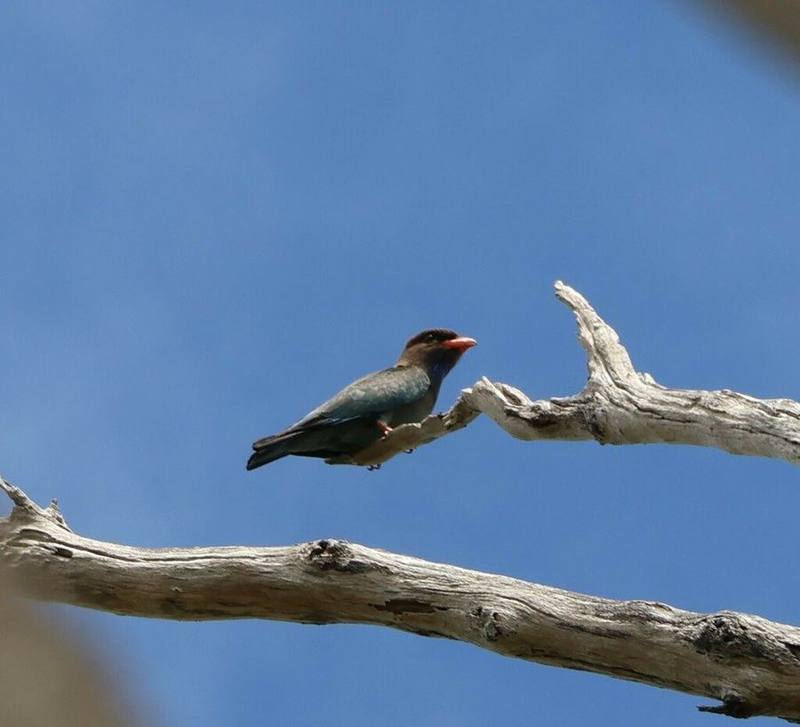
Photo: Greg Tasney · CC BY-SA 4.0 (May be cropped or resized)
Eurystomus orientalis
Rare visitor: recorded only occasionally in this country
Basic stats
Diet
Flying insects
Habitat
Open woodland with hole-bearing trees
Range
Australia to Korea, Japan and India
Size
27–32cm
The Oriental dollarbird is a member of the roller family, 27–32cm long, named for the pale blue or white coin-shaped patches on its wings, which show well in flight. It is dark brown heavily washed with blue-green on the back and wing coverts, with a glossy bright blue throat and undertail and darker blue flight feathers. The short, wide bill is orange-red with a black tip in adults. Females are slightly duller, and immatures are much duller, with no blue on the throat and dark bills and feet (Wikipedia, general species account).
It is usually seen alone, sitting upright on a bare branch high in a tree, from which it hawks flying insects, often returning to the same perch within seconds. It prefers open woodland with trees that have holes for nesting. Some populations are migratory, including those that breed in north-east Asia and in northern and eastern Australia. Ten subspecies are recognised. In India it is a resident forest bird with a moderate range; SoIB 2023 finds its trends stable and rates it a Low conservation priority (Wikipedia, general species account; SoIB 2023).
Quick answers
- What does the Oriental Dollarbird eat?
- Flying insects
- What habitat does the Oriental Dollarbird live in?
- Open woodland with hole-bearing trees
- Where is the Oriental Dollarbird found?
- Australia to Korea, Japan and India
- How big is the Oriental Dollarbird?
- 27–32cm
In Vietnam
GBIF holds 2,151 records of the Oriental Dollarbird from 14 protected areas in Vietnam, dated 1984 to 2026. Most come from Cat Tien National Park and Cuc Phuong National Park.
Where it has been recorded
- Cat Tien National Park 1,915 records, latest 2026
- Cuc Phuong National Park 117 records, latest 2024
- Dong Nai Culture and Nature Reserve 23 records, latest 2024
- Phong Nha-Ke Bang National Park 15 records, latest 2024
- Cat Ba National Park 13 records, latest 2024
- Phu Quoc National Park 12 records, latest 2023
- Yok Don National Park 12 records, latest 2019
- Lo Go - Xa Mat National Park 9 records, latest 2001
Plus 6 more sites.
Covered in our place guides: Cat Tien National Park, Cuc Phuong National Park, Phong Nha-Ke Bang National Park, Yok Don National Park, Bach Ma National Park, Da Lat Plateau & Bidoup-Nui Ba.
Also in our other guides: India, Mongolia, Nepal, Singapore, Sri Lanka, Sulawesi, Thailand.
Records: GBIF occurrence data matched to park boundaries (© OpenStreetMap contributors, ODbL; Wikidata). Counts show recording effort, not how common the species is.