
 Wildlife
of Vietnam
Lesser Coucal
Cuckoos & Coucals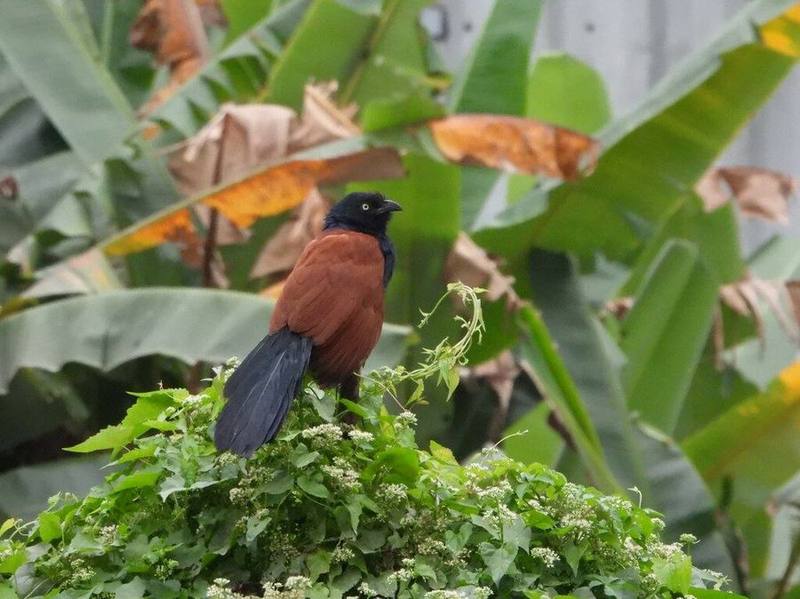
Photo: Stephen Matthews · CC0 1.0
Centropus bengalensis
Rare visitor: recorded only occasionally in this country
Basic stats
Habitat
Marshy and grassy land with scattered trees, mainly in lowlands
Range
Indian subcontinent to Southeast Asia, China and the Philippines
The lesser coucal is a blackish, long-tailed coucal with rufous wings, smaller and shorter-billed than the greater coucal, with a darker brown rather than crimson eye and the longest hind claw of any coucal. It is one of the few coucals with seasonal plumages: in breeding dress the head and upper back are glossy, while outside the breeding season the feather shafts on the head and back show as whitish streaks. The sexes cannot be told apart in the field. Juveniles are browner with black spots and bars (Wikipedia, general species account).
It is found singly or in pairs low in the undergrowth of marshy or grassy areas next to forest, mainly in the lowlands. Its calls include a series of low, double whoot-woot or kurook notes that speed up and fall in pitch. Like other coucals it raises its own young: it builds a dome of grass blades in a low tree, and both sexes incubate and care for the chicks. In India it is resident with a moderate range; SoIB 2023 finds its long-term trend stable and rates it a Low conservation priority (Wikipedia, general species account; SoIB 2023).
Quick answers
- What habitat does the Lesser Coucal live in?
- Marshy and grassy land with scattered trees, mainly in lowlands
- Where is the Lesser Coucal found?
- Indian subcontinent to Southeast Asia, China and the Philippines
In Vietnam
GBIF holds 848 records of the Lesser Coucal from 15 protected areas in Vietnam, dated 1988 to 2024. Most come from Cat Tien National Park and Cuc Phuong National Park.
Where it has been recorded
- Cat Tien National Park 711 records, latest 2024
- Cuc Phuong National Park 30 records, latest 2024
- Bach Ma National Park 18 records, latest 2024
- Van Long Nature Reserve 13 records, latest 2024
- Phong Nha-Ke Bang National Park 13 records, latest 2024
- Phja Oac - Phja Den National Park 10 records, latest 2023
- Dong Nai Culture and Nature Reserve 10 records, latest 2024
- Tam Dao National Park 9 records, latest 2023
Plus 7 more sites.
Covered in our place guides: Cat Tien National Park, Cuc Phuong National Park, Bach Ma National Park, Van Long Nature Reserve, Phong Nha-Ke Bang National Park, Hoang Lien National Park (Sa Pa).
Also in our other guides: India, Korea, Sulawesi.
Records: GBIF occurrence data matched to park boundaries (© OpenStreetMap contributors, ODbL; Wikidata). Counts show recording effort, not how common the species is.