
 Wildlife
of Vietnam
Indian Paradise Flycatcher
Crows, Drongos, Orioles & Shrikes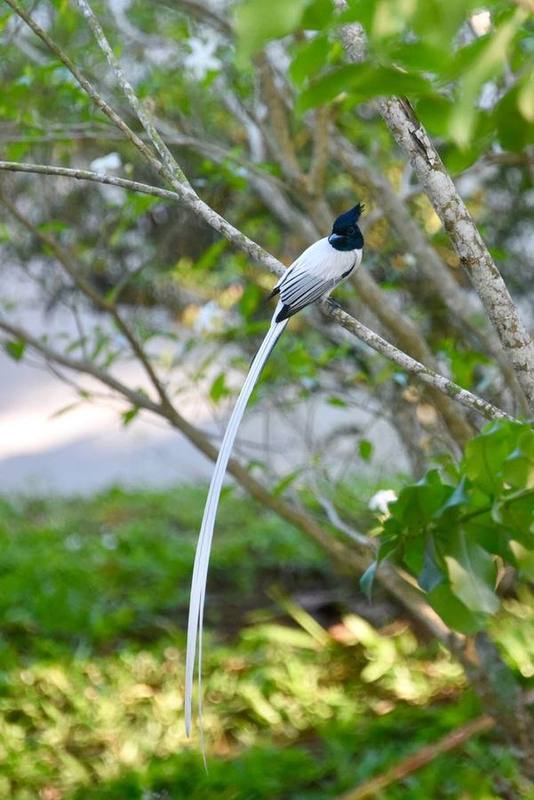
Photo: melianie_max_and_asker · CC BY 4.0 (May be cropped or resized)
Terpsiphone paradisi
Rare visitor: recorded only occasionally in this country
Basic stats
Diet
Insects, caught in flight
Range
Indian subcontinent and parts of Central Asia and China
Size
19–22cm, plus male tail streamers up to 30cm
The Indian paradise flycatcher is a medium-sized monarch flycatcher. Adults are 19–22cm long, but males grow two drooping central tail streamers up to 30cm long in their second or third year. Both sexes have a glossy black head with a crest and a sturdy black bill. Adult males are either mainly bright rufous above or mainly white, with some intermediates, while females are rufous above with a greyish throat and underparts and a short tail. Young males look like females but have a black throat (Wikipedia, general species account).
It feeds on insects, including grasshoppers, butterflies, mantises and flies, usually catching them in the air, then beating them against a perch and eating the softer parts. It breeds across most of the Indian subcontinent and in parts of Central Asia and China. SoIB 2023 lists it as resident in India with movements within the country and a large range, finds its current trend stable, and rates it a Low conservation priority (Wikipedia, general species account; SoIB 2023).
Quick answers
- What does the Indian Paradise Flycatcher eat?
- Insects, caught in flight
- Where is the Indian Paradise Flycatcher found?
- Indian subcontinent and parts of Central Asia and China
- How big is the Indian Paradise Flycatcher?
- 19–22cm, plus male tail streamers up to 30cm
In Vietnam
GBIF holds 494 records of the Indian Paradise Flycatcher from 10 protected areas in Vietnam, dated 1988 to 2024. Most come from Cat Tien National Park and Cuc Phuong National Park.
Where it has been recorded
- Cat Tien National Park 292 records, latest 2024
- Cuc Phuong National Park 69 records, latest 2024
- Bach Ma National Park 47 records, latest 2024
- Dong Nai Culture and Nature Reserve 37 records, latest 2024
- Phong Nha-Ke Bang National Park 26 records, latest 2024
- Ngoc Linh Nature Reserve 7 records, latest 2024
- Ba Vi National Park 5 records, latest 2024
- Tam Dao National Park 4 records, latest 2018
Plus 2 more sites.
Covered in our place guides: Cat Tien National Park, Cuc Phuong National Park, Bach Ma National Park, Phong Nha-Ke Bang National Park.
Also in our other guides: India, Nepal.
Records: GBIF occurrence data matched to park boundaries (© OpenStreetMap contributors, ODbL; Wikidata). Counts show recording effort, not how common the species is.