
 Wildlife
of Vietnam
Himalayan Swiftlet
Nightjars, Frogmouths & Swifts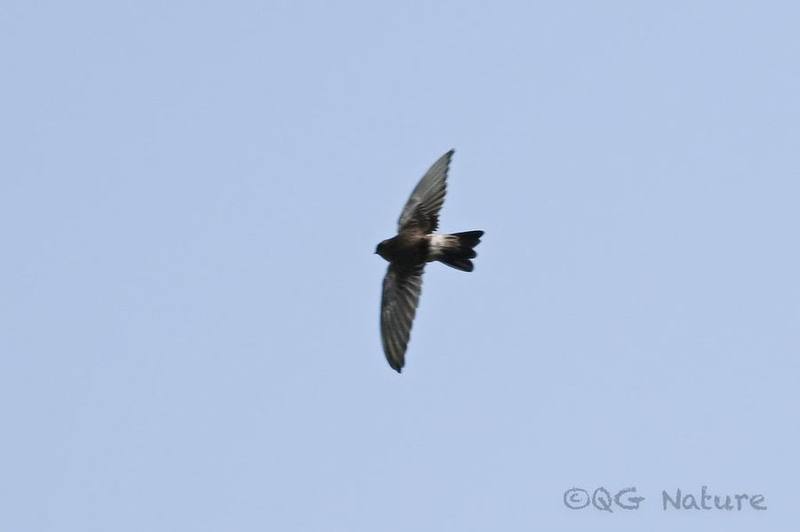
Photo: (c) Wang.QG, some rights reserved (CC BY) · CC-BY (May be cropped or resized)
Aerodramus brevirostris
Rare visitor: recorded only occasionally in this country
Basic stats
Diet
Invertebrates
Habitat
Colonial breeder in the Himalaya; breeds up to above 4,500m, winters at 900–2,750m
Range
Himalaya east to Bangladesh, Myanmar and Thailand, and Southeast Asia
Clutch size
2 white eggs
Size
13–14cm
The Himalayan swiftlet is a small swift, 13–14 cm long, with swept-back wings like a crescent or boomerang, a slender body and a forked tail. It is mainly grey-brown above and paler brown below, with a pale grey rump and a pale patch above and behind the bill. Its roosting call is a twittering chit-chit, and it also has a piercing teeree-teeree-teeree; clicks are followed by twittering as it approaches its nest (Wikipedia, general species account).
It is a common colonial breeder in the Himalaya and Southeast Asia; the nominate race breeds in the Himalaya east to Bangladesh, Myanmar and Thailand and is an altitudinal migrant, breeding up to above 4,500 m and wintering between 900 and 2,750 m. Nests of this colonial swift may touch, and the clutch is two white eggs.
Quick answers
- What does the Himalayan Swiftlet eat?
- Invertebrates
- What habitat does the Himalayan Swiftlet live in?
- Colonial breeder in the Himalaya; breeds up to above 4,500m, winters at 900–2,750m
- Where is the Himalayan Swiftlet found?
- Himalaya east to Bangladesh, Myanmar and Thailand, and Southeast Asia
- How many eggs does the Himalayan Swiftlet lay?
- 2 white eggs
- How big is the Himalayan Swiftlet?
- 13–14cm
In Vietnam
GBIF holds 80 records of the Himalayan Swiftlet from 9 protected areas in Vietnam, dated 1990 to 2024. Most come from Da Lat Plateau & Bidoup-Nui Ba and Cat Tien National Park.
Where it has been recorded
- Da Lat Plateau & Bidoup-Nui Ba 30 records, latest 2024
- Cat Tien National Park 11 records, latest 2022
- Cuc Phuong National Park 10 records, latest 2019
- Hoang Lien National Park (Sa Pa) 9 records, latest 2023
- Phong Nha-Ke Bang National Park 6 records, latest 2024
- Ha Long Bay - Cat Ba Archipelago 4 records, latest 2024
- Ngoc Linh Nature Reserve 4 records, latest 2024
- Van Long Nature Reserve 3 records, latest 2024
Plus 1 more sites.
Covered in our place guides: Da Lat Plateau & Bidoup-Nui Ba, Cat Tien National Park, Cuc Phuong National Park, Hoang Lien National Park (Sa Pa), Phong Nha-Ke Bang National Park, Van Long Nature Reserve.
Also in our other guides: China, India, Korea, Malaysia.
Records: GBIF occurrence data matched to park boundaries (© OpenStreetMap contributors, ODbL; Wikidata). Counts show recording effort, not how common the species is.