
 Wildlife
of Vietnam
Grey Nightjar
Nightjars, Frogmouths & Swifts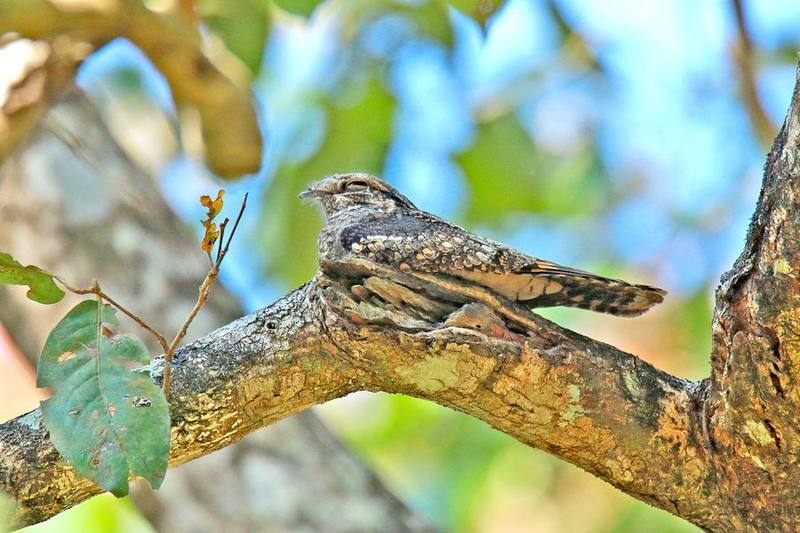
Photo: Drsssuresh1961 · CC BY-SA 4.0 (May be cropped or resized)
Caprimulgus jotaka
Rare visitor: recorded only occasionally in this country
Basic stats
Diet
Flying insects: moths, beetles, flying ants and grasshoppers
Habitat
Forest, shrubland, cliffs and anthropogenic structures, up to about 3,300m
Range
East Asia and westward along the Himalaya
Clutch size
2 eggs; one nesting cycle a year
The grey nightjar is a medium-sized nightjar with a large head, large eye, long tail, weak bill and short legs, with mottled plumage very like that of the Himalayan subspecies of the jungle nightjar. The feathers on the nape have pale brown spots at the tips. It breeds from south-eastern Russia south through China, the Korean Peninsula and Japan to northern Indochina and westward along the Himalaya (Wikipedia, general species account).
It is largely migratory, wintering in Indochina south to Java, but resident in warmer areas in the south of its breeding range. Its habitat can be up to 3,300 m and includes forest, shrubland, cliffs and buildings. Crepuscular to nocturnal, it feeds on flying insects, and its song is a series of hollow byuck notes lasting 2–4 seconds. Breeding is between May and July, with two eggs per clutch and one nesting cycle a year. SoIB 2023 lists it as a resident and summer migrant of non-specialised habitat that eats invertebrates, and does not assign a priority category (Wikipedia, general species account; SoIB 2023).
Quick answers
- What does the Grey Nightjar eat?
- Flying insects: moths, beetles, flying ants and grasshoppers
- What habitat does the Grey Nightjar live in?
- Forest, shrubland, cliffs and anthropogenic structures, up to about 3,300m
- Where is the Grey Nightjar found?
- East Asia and westward along the Himalaya
- How many eggs does the Grey Nightjar lay?
- 2 eggs; one nesting cycle a year
In Vietnam
GBIF holds 85 records of the Grey Nightjar from 7 protected areas in Vietnam, dated 1990 to 2026. Most come from Da Lat Plateau & Bidoup-Nui Ba and Phong Nha-Ke Bang National Park.
Where it has been recorded
- Da Lat Plateau & Bidoup-Nui Ba 31 records, latest 2024
- Phong Nha-Ke Bang National Park 13 records, latest 2025
- Bach Ma National Park 12 records, latest 2022
- Cuc Phuong National Park 10 records, latest 2020
- Hoang Lien National Park (Sa Pa) 9 records, latest 2019
- Cat Tien National Park 6 records, latest 2026
- Ngoc Linh Nature Reserve 4 records, latest 2021
Covered in our place guides: Da Lat Plateau & Bidoup-Nui Ba, Phong Nha-Ke Bang National Park, Bach Ma National Park, Cuc Phuong National Park, Hoang Lien National Park (Sa Pa), Cat Tien National Park.
Also in our other guides: India, Malaysia, Singapore, Sumatra, Thailand.
Records: GBIF occurrence data matched to park boundaries (© OpenStreetMap contributors, ODbL; Wikidata). Counts show recording effort, not how common the species is.