
 Wildlife
of Vietnam
Eurasian Woodcock
Shorebirds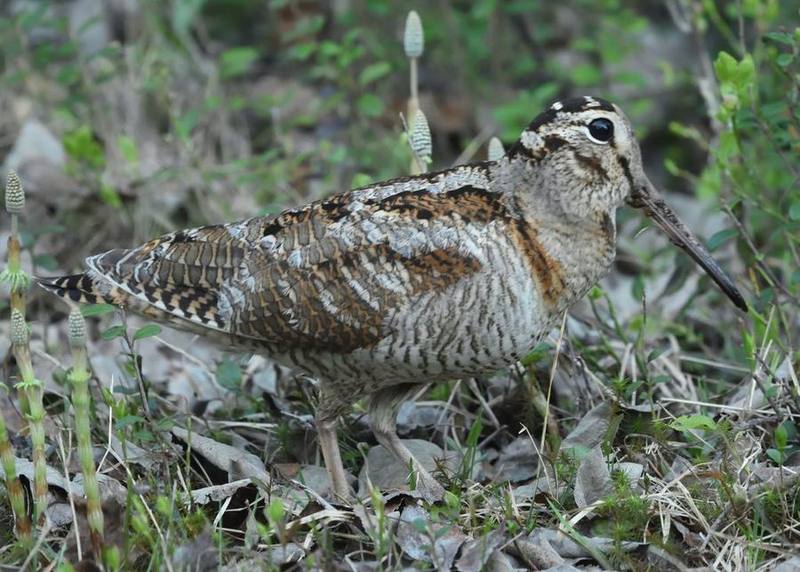
Photo: (c) Guy Babineau, some rights reserved (CC BY) · CC BY 4.0 (May be cropped or resized)
Scolopax rusticola
Rare visitor: recorded only occasionally in this country
Basic stats
Habitat
Woodland, preferring woods away from urban areas
Range
Temperate and subarctic Eurasia; Asian populations migrate to the Indian subcontinent
Clutch size
1–2 white or creamy eggs with light brown and grey blotches
Incubation period
21–24 days
Size
33–38cm including a 6–8cm bill
Wingspan
55–65cm
The Eurasian woodcock is a medium-small wader with cryptic camouflage suited to woodland: intricately patterned reddish-brown upperparts and buff underparts. The head is barred with black rather than striped like its snipe relatives, the wings are rounded, and the bill base is flesh-coloured with a dark tip. Adults are 33 to 38cm long including a straight 6 to 8cm bill (Wikipedia, general species account).
It breeds across temperate and subarctic Eurasia, and Asian populations migrate to the Indian subcontinent, the account opened says. A single brood of one or two eggs is laid, and incubation is by the female alone for 21 to 24 days. The world population is estimated at 14 to 16 million birds. The sources read give nothing specific to Bhutan.
Quick answers
- What habitat does the Eurasian Woodcock live in?
- Woodland, preferring woods away from urban areas
- Where is the Eurasian Woodcock found?
- Temperate and subarctic Eurasia; Asian populations migrate to the Indian subcontinent
- How many eggs does the Eurasian Woodcock lay?
- 1–2 white or creamy eggs with light brown and grey blotches
- How long are the eggs of the Eurasian Woodcock incubated?
- 21–24 days
- How big is the Eurasian Woodcock?
- 33–38cm including a 6–8cm bill
- What is the wingspan of the Eurasian Woodcock?
- 55–65cm
In Vietnam
GBIF holds 58 records of the Eurasian Woodcock from 5 protected areas in Vietnam, dated 1995 to 2024. Most come from Cuc Phuong National Park and Tam Dao National Park.
Where it has been recorded
- Cuc Phuong National Park 37 records, latest 2024
- Tam Dao National Park 10 records, latest 2016
- Ba Vi National Park 4 records, latest 2011
- Son Tra special-use forest 4 records, latest 2023
- Phja Oac - Phja Den National Park 3 records, latest 2022
Covered in our place guides: Cuc Phuong National Park.
Also in our other guides: Bhutan.
Records: GBIF occurrence data matched to park boundaries (© OpenStreetMap contributors, ODbL; Wikidata). Counts show recording effort, not how common the species is.