
 Wildlife
of Vietnam
Crested Honey Buzzard
Birds of Prey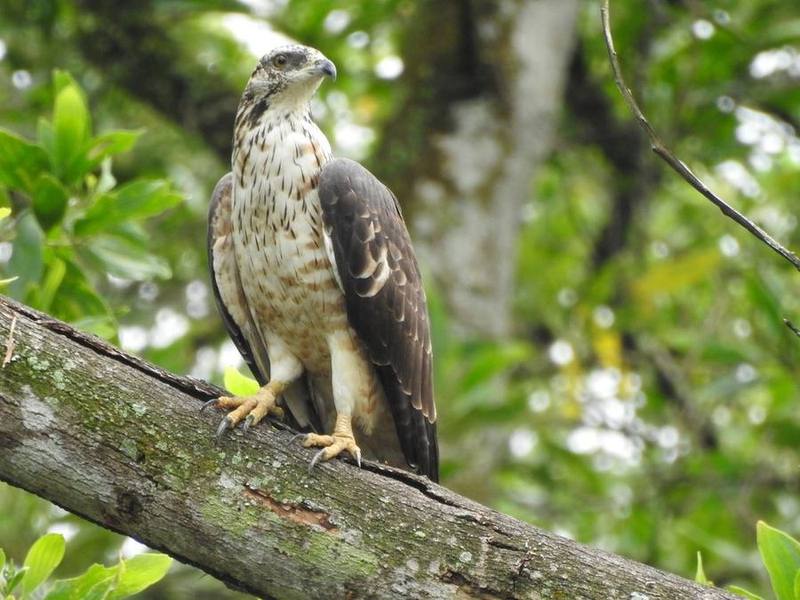
Photo: anukma · CC BY 4.0 (May be cropped or resized)
Pernis ptilorhynchus
Rare visitor: recorded only occasionally in this country
Basic stats
Diet
Mainly larvae of bees and wasps taken from combs
Habitat
Well-forested areas with open spaces, sea level to 1,800m
Range
Breeds from Siberia and Japan to South and Southeast Asia
Size
57–60cm
Weight
750–1,490g
The crested honey buzzard is a fairly large raptor, 57–60cm long and 750–1,490g, larger than the European honey buzzard. It has a small, pigeon-like head on a long neck without a strong brow ridge, a long tail and a short crest, and is brown above and paler below with a dark throat stripe. Unusually for a large raptor the sexes differ: the male has a blue-grey head, brown eyes and two black tail bands, while the slightly larger, darker female has a brown head, yellow eyes and three tail bands (Wikipedia, general species account).
It feeds mainly on the larvae of bees and wasps taken from combs, and is well adapted to its diet: an elongated head for digging at underground nests, a grooved tongue for extracting grubs, and dense, scale-like feathers on the head and neck that protect it from stings. It prefers well-forested country with open spaces from sea level to 1,800m. Some birds breed in Siberia and Japan and winter further south, while others are resident. SoIB 2023 lists it as resident and a winter migrant in India, finds its trends stable, and rates it a Low conservation priority (Wikipedia, general species account; SoIB 2023).
Quick answers
- What does the Crested Honey Buzzard eat?
- Mainly larvae of bees and wasps taken from combs
- What habitat does the Crested Honey Buzzard live in?
- Well-forested areas with open spaces, sea level to 1,800m
- Where is the Crested Honey Buzzard found?
- Breeds from Siberia and Japan to South and Southeast Asia
- How big is the Crested Honey Buzzard?
- 57–60cm
- How much does the Crested Honey Buzzard weigh?
- 750–1,490g
In Vietnam
GBIF holds 566 records of the Crested Honey Buzzard from 20 protected areas in Vietnam, dated 1987 to 2026. Most come from Cat Tien National Park and Da Lat Plateau & Bidoup-Nui Ba.
Where it has been recorded
- Cat Tien National Park 273 records, latest 2026
- Da Lat Plateau & Bidoup-Nui Ba 50 records, latest 2024
- Cuc Phuong National Park 40 records, latest 2026
- Son Tra special-use forest 35 records, latest 2026
- Phong Nha-Ke Bang National Park 32 records, latest 2024
- Tam Dao National Park 27 records, latest 2024
- Bach Ma National Park 17 records, latest 2024
- Ngoc Linh Nature Reserve 14 records, latest 2024
Plus 12 more sites.
Covered in our place guides: Cat Tien National Park, Da Lat Plateau & Bidoup-Nui Ba, Cuc Phuong National Park, Phong Nha-Ke Bang National Park, Bach Ma National Park, Hoang Lien National Park (Sa Pa).
Seen on trips we host
- Birding with a Camera (Dorian Anderson) Tropical Birding, 2025
- Vietnam 2026 Bird Tour Asia, 2026
Also in our other guides: India, Nepal.
Records: GBIF occurrence data matched to park boundaries (© OpenStreetMap contributors, ODbL; Wikidata). Counts show recording effort, not how common the species is.