
 Wildlife
of Vietnam
Collared Owlet
Owls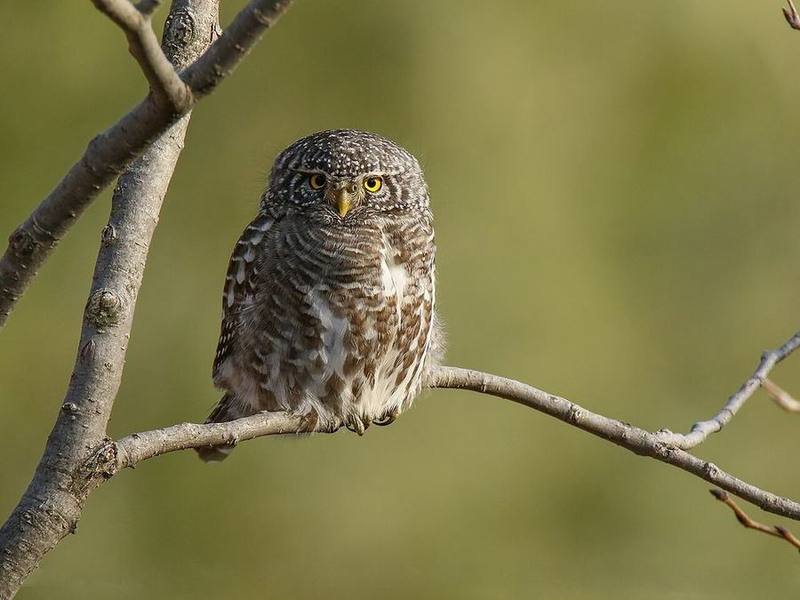
Photo: Imran Shah from Islamabad, Pakistan · CC BY-SA 2.0 (May be cropped or resized)
Taenioptynx brodiei
Also known as: Glaucidium brodiei
Rare visitor: recorded only occasionally in this country
Basic stats
Habitat
Submontane and montane forest with open spaces; nests in tree hollows and old woodpecker or barbet holes
Range
Bhutan, India, Nepal, Pakistan, China, Taiwan and Southeast Asia
Clutch size
3–5 round white eggs
Size
15–17cm
Weight
About 52g in males; about 63g in females
The collared owlet, or collared pygmy owl, is the smallest owl in Asia, 15 to 17cm long and weighing about 60g, with females slightly larger than males. It is grey-brown with a barred back and flanks, a spotted head, prominent white eyebrows, lemon-yellow eyes and a white throat patch. The pale collar and two black spots on each side of the nape imitate eye spots, so the owl seems to stare from behind (Wikipedia, general species account).
It lives in submontane and montane forest with open spaces across Asia, including Bhutan, and is mainly diurnal, perching, hunting and calling for most of the day and sometimes at night. Its call starts mellow and becomes shriller with excitement, while the head turns in all directions, making it hard to locate. It does not make its own nest but uses tree hollows or old woodpecker and barbet holes, laying three to five round white eggs.
Quick answers
- What habitat does the Collared Owlet live in?
- Submontane and montane forest with open spaces; nests in tree hollows and old woodpecker or barbet holes
- Where is the Collared Owlet found?
- Bhutan, India, Nepal, Pakistan, China, Taiwan and Southeast Asia
- How many eggs does the Collared Owlet lay?
- 3–5 round white eggs
- How big is the Collared Owlet?
- 15–17cm
- How much does the Collared Owlet weigh?
- About 52g in males; about 63g in females
In Vietnam
GBIF holds 986 records of the Collared Owlet from 13 protected areas in Vietnam, dated 1988 to 2024. Most come from Bach Ma National Park and Cuc Phuong National Park.
Where it has been recorded
- Bach Ma National Park 222 records, latest 2024
- Cuc Phuong National Park 171 records, latest 2024
- Da Lat Plateau & Bidoup-Nui Ba 170 records, latest 2024
- Phong Nha-Ke Bang National Park 150 records, latest 2024
- Tam Dao National Park 100 records, latest 2023
- Ngoc Linh Nature Reserve 85 records, latest 2024
- Cat Tien National Park 33 records, latest 2024
- Bac Huong Hoa Nature Reserve 30 records, latest 2024
Plus 5 more sites.
Covered in our place guides: Bach Ma National Park, Cuc Phuong National Park, Da Lat Plateau & Bidoup-Nui Ba, Phong Nha-Ke Bang National Park, Cat Tien National Park.
Seen on trips we host
- Vietnam scheduled Bird Tour Asia, 2018
Also in our other guides: Bhutan.
Records: GBIF occurrence data matched to park boundaries (© OpenStreetMap contributors, ODbL; Wikidata). Counts show recording effort, not how common the species is.