
 Wildlife
of Vietnam
Brown-backed Needletail
Nightjars, Frogmouths & Swifts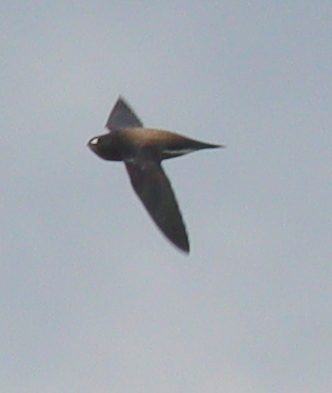
Photo: Jan Ebr & Ivana Ebrová · CC BY 4.0 (May be cropped or resized)
Hirundapus giganteus
Rare visitor: recorded only occasionally in this country
Basic stats
Diet
Flying insects
Habitat
Hill forest
Range
Southern India and Southeast Asia to the Greater Sundas and Palawan
Clutch size
3–5 eggs
Size
About 23cm
The brown-backed needletail is among the largest swifts in the world. At about 23cm it is bigger than the alpine swift and the white-throated needletail, with a heavy, barrel-shaped body. It is dark brown except for a white undertail that extends onto the flanks. Its name comes from the spiny tips of the tail feathers, more prominent than in other needletails. Its flight is very fast, even for a swift (Wikipedia, general species account).
It is a resident breeder in hill forests of southern India and Southeast Asia, reaching the Greater Sunda Islands and Palawan in the Philippines. It nests in rock crevices in cliffs and lays three to five eggs. Like other swifts it spends most of its life in the air, catching insects in its bill, and uses its short legs only for clinging to vertical surfaces. SoIB 2023 lists it as resident and a summer migrant in India with a moderate range, estimates a long-term decline of about 69%, and rates it a Moderate conservation priority (Wikipedia, general species account; SoIB 2023).
Quick answers
- What does the Brown-backed Needletail eat?
- Flying insects
- What habitat does the Brown-backed Needletail live in?
- Hill forest
- Where is the Brown-backed Needletail found?
- Southern India and Southeast Asia to the Greater Sundas and Palawan
- How many eggs does the Brown-backed Needletail lay?
- 3–5 eggs
- How big is the Brown-backed Needletail?
- About 23cm
In Vietnam
GBIF holds 329 records of the Brown-backed Needletail from 11 protected areas in Vietnam, dated 1988 to 2024. Most come from Cat Tien National Park and Cuc Phuong National Park.
Where it has been recorded
- Cat Tien National Park 221 records, latest 2024
- Cuc Phuong National Park 44 records, latest 2024
- Tam Dao National Park 21 records, latest 2024
- Phong Nha-Ke Bang National Park 11 records, latest 2024
- Ngoc Linh Nature Reserve 7 records, latest 2024
- Hoang Lien National Park (Sa Pa) 6 records, latest 2024
- Bach Ma National Park 6 records, latest 2024
- Dong Nai Culture and Nature Reserve 4 records, latest 2024
Plus 3 more sites.
Covered in our place guides: Cat Tien National Park, Cuc Phuong National Park, Phong Nha-Ke Bang National Park, Hoang Lien National Park (Sa Pa), Bach Ma National Park, Da Lat Plateau & Bidoup-Nui Ba.
Seen on trips we host
- Vietnam scheduled Bird Tour Asia, 2015
- Vietnam 2026 Bird Tour Asia, 2026
Also in our other guides: India, Malaysia, Singapore, Sri Lanka, Sumatra, Thailand.
Records: GBIF occurrence data matched to park boundaries (© OpenStreetMap contributors, ODbL; Wikidata). Counts show recording effort, not how common the species is.