
 Wildlife
of Vietnam
Bronzed Drongo
Crows, Drongos, Orioles & Shrikes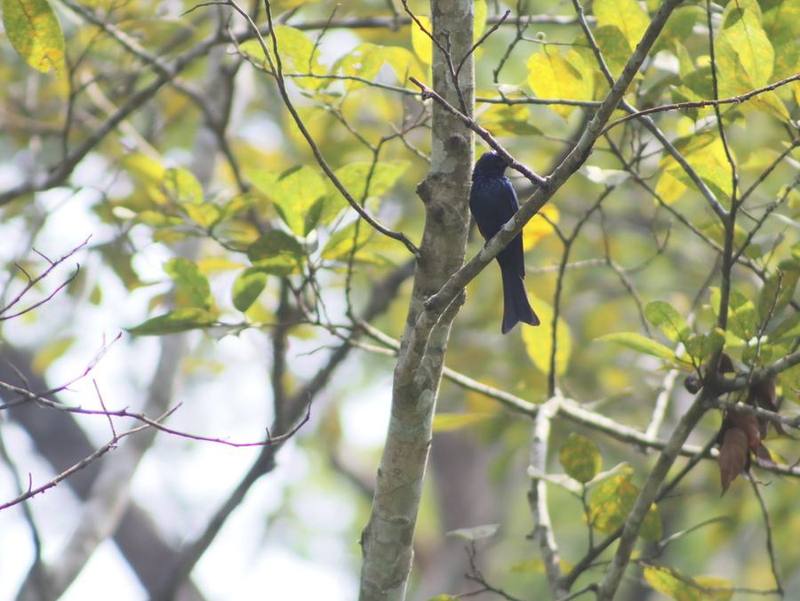
Photo: Ashwin (iNaturalist) · CC BY 4.0 (May be cropped or resized)
Dicrurus aeneus
Rare visitor: recorded only occasionally in this country
Basic stats
Diet
Insects caught in aerial sallies under the forest canopy
Habitat
Forests of the Indian subcontinent and Southeast Asia; cup nest in a tree covered in cobwebs
Clutch size
3–4 pinkish to brownish eggs
Size
24cm
The bronzed drongo is a small drongo, 24cm long, somewhat smaller than the black drongo and with more metallic gloss, spangled on the head, neck and breast. The tail is slender and well forked with the outer feathers flaring slightly. It is aggressive and fearless and will attack much larger birds if its nest or young are threatened (Wikipedia, general species account).
It is resident in the forests of the Indian subcontinent and Southeast Asia, found singly or in groups of two or three, foraging for insects under the canopy by aerial sallies from favourite perches, and sometimes joining mixed-species flocks. It mimics the calls of many other birds. The breeding season is February to July, with a cobweb-covered, often whitish cup nest and three or four eggs.
Quick answers
- What does the Bronzed Drongo eat?
- Insects caught in aerial sallies under the forest canopy
- What habitat does the Bronzed Drongo live in?
- Forests of the Indian subcontinent and Southeast Asia; cup nest in a tree covered in cobwebs
- How many eggs does the Bronzed Drongo lay?
- 3–4 pinkish to brownish eggs
- How big is the Bronzed Drongo?
- 24cm
In Vietnam
GBIF holds 2,621 records of the Bronzed Drongo from 16 protected areas in Vietnam, dated 1984 to 2026. Most come from Cat Tien National Park and Phong Nha-Ke Bang National Park.
Where it has been recorded
- Cat Tien National Park 2,253 records, latest 2026
- Phong Nha-Ke Bang National Park 142 records, latest 2024
- Cuc Phuong National Park 57 records, latest 2024
- Dong Nai Culture and Nature Reserve 40 records, latest 2024
- Bach Ma National Park 30 records, latest 2025
- Xuan Lien National Park 19 records, latest 2022
- Yok Don National Park 17 records, latest 2022
- Da Lat Plateau & Bidoup-Nui Ba 16 records, latest 2024
Plus 8 more sites.
Covered in our place guides: Cat Tien National Park, Phong Nha-Ke Bang National Park, Cuc Phuong National Park, Bach Ma National Park, Yok Don National Park, Da Lat Plateau & Bidoup-Nui Ba.
Seen on trips we host
- Vietnam Bird Tour Asia, 2024
Also in our other guides: Bhutan.
Records: GBIF occurrence data matched to park boundaries (© OpenStreetMap contributors, ODbL; Wikidata). Counts show recording effort, not how common the species is.