
 Wildlife
of Vietnam
Black-capped Kingfisher
Kingfishers, Bee-eaters & Rollers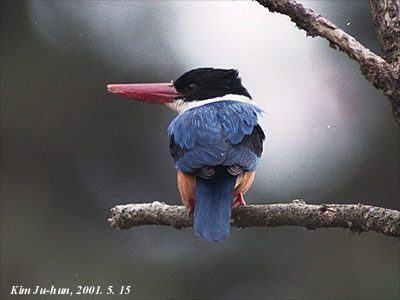
Photo: Kim, Hyun-tae · CC BY 4.0 (May be cropped or resized)
Halcyon pileata
Rare visitor: recorded only occasionally in this country
Basic stats
Diet
Fish and large insects
Habitat
Coasts, mangroves, estuaries and rivers; sometimes far inland
Range
Tropical Asia from India east to China, Korea and Southeast Asia
Clutch size
4–5 eggs
Size
About 28cm
The black-capped kingfisher is a tree kingfisher about 28cm long, with purple-blue wings and back, a black head and shoulders, a white collar and throat, rufous underparts and a large coral-red bill and legs. In flight it shows large white patches at the base of the primaries on its blue and black wings, and it flies fast and direct on whirring wings. The sexes are similar; juveniles are duller with streaks on the throat. Its call is a cackling ki-ki-ki-ki-ki (Wikipedia, general species account).
It lives mainly on coasts, especially in mangroves, and along estuaries and rivers, but sometimes far inland. It perches conspicuously but is easily disturbed, and dives for fish as well as taking large insects. It nests in a tunnel in an earth bank, laying four or five round white eggs in summer. It is the most northerly of the tree kingfishers; northern populations migrate south for the winter. In India it is a winter migrant. SoIB 2023 estimates a long-term decline of about 89% and a current fall of about 6% a year, and rates it a High conservation priority (Wikipedia, general species account; SoIB 2023).
Quick answers
- What does the Black-capped Kingfisher eat?
- Fish and large insects
- What habitat does the Black-capped Kingfisher live in?
- Coasts, mangroves, estuaries and rivers; sometimes far inland
- Where is the Black-capped Kingfisher found?
- Tropical Asia from India east to China, Korea and Southeast Asia
- How many eggs does the Black-capped Kingfisher lay?
- 4–5 eggs
- How big is the Black-capped Kingfisher?
- About 28cm
In Vietnam
GBIF holds 323 records of the Black-capped Kingfisher from 13 protected areas in Vietnam, dated 1986 to 2025. Most come from Cat Tien National Park and Tram Chim National Park.
Where it has been recorded
- Cat Tien National Park 249 records, latest 2024
- Tram Chim National Park 16 records, latest 2024
- Cuc Phuong National Park 11 records, latest 2022
- Van Long Nature Reserve 8 records, latest 2024
- Bach Ma National Park 7 records, latest 2023
- Cat Ba National Park 6 records, latest 2019
- Dong Nai Culture and Nature Reserve 6 records, latest 2021
- Mui Ca Mau National Park 5 records, latest 2025
Plus 5 more sites.
Covered in our place guides: Cat Tien National Park, Tram Chim National Park, Cuc Phuong National Park, Van Long Nature Reserve, Bach Ma National Park, Con Dao National Park.
Seen on trips we host
- Vietnam scheduled Bird Tour Asia, 2018
Also in our other guides: India, Nepal.
Records: GBIF occurrence data matched to park boundaries (© OpenStreetMap contributors, ODbL; Wikidata). Counts show recording effort, not how common the species is.